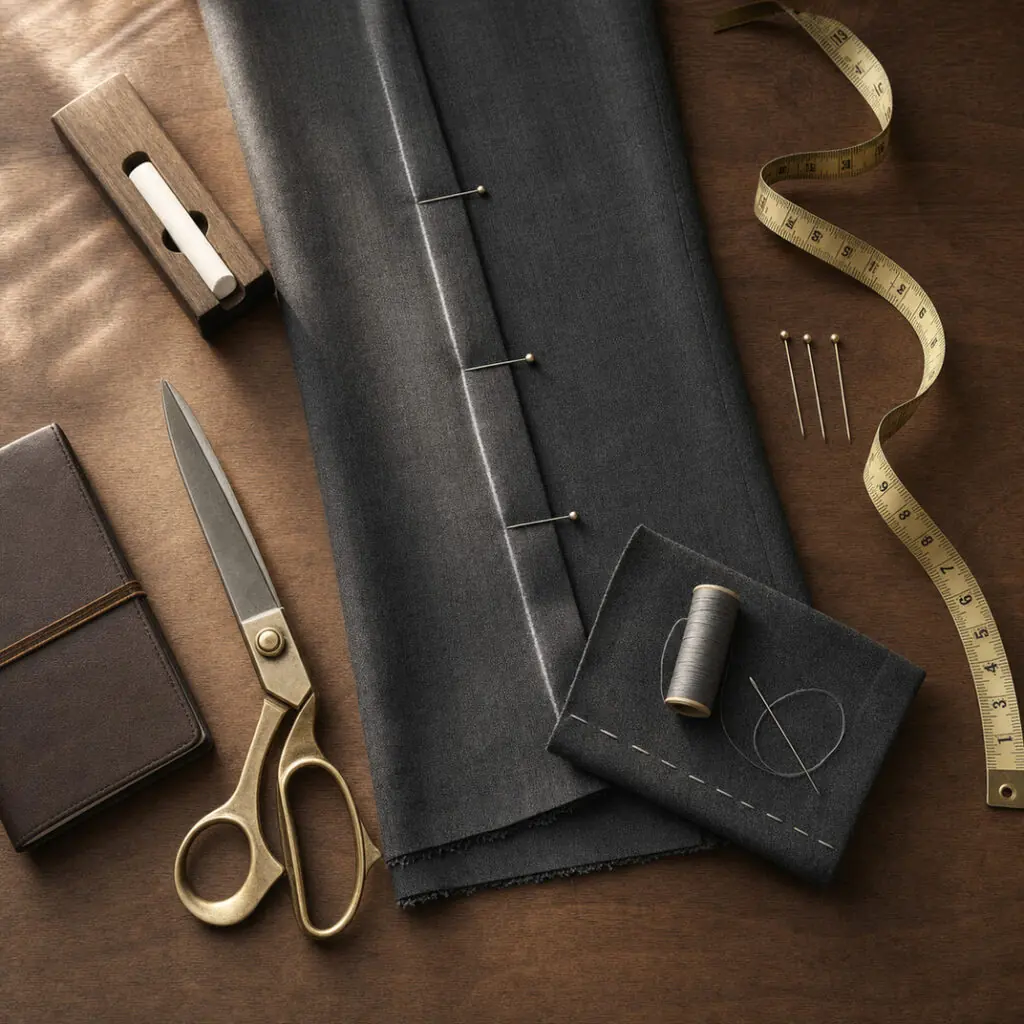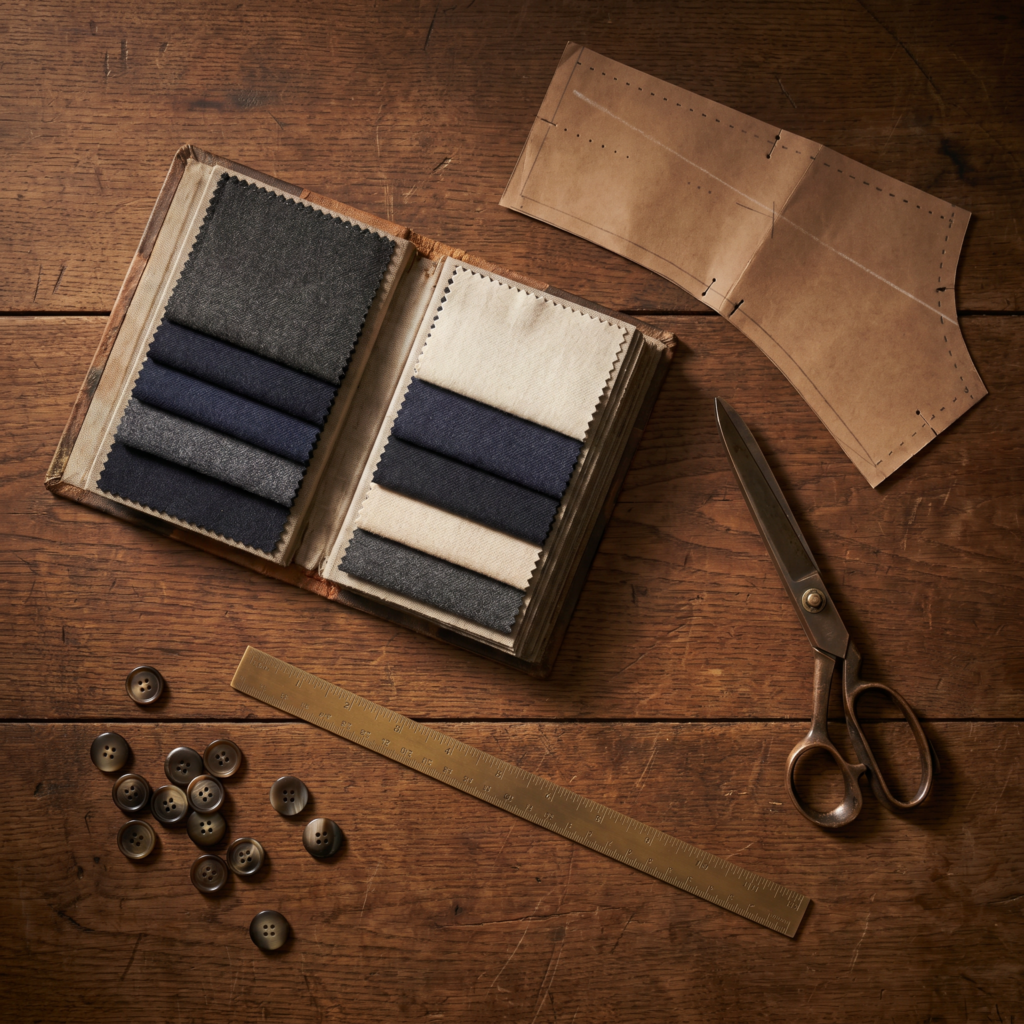
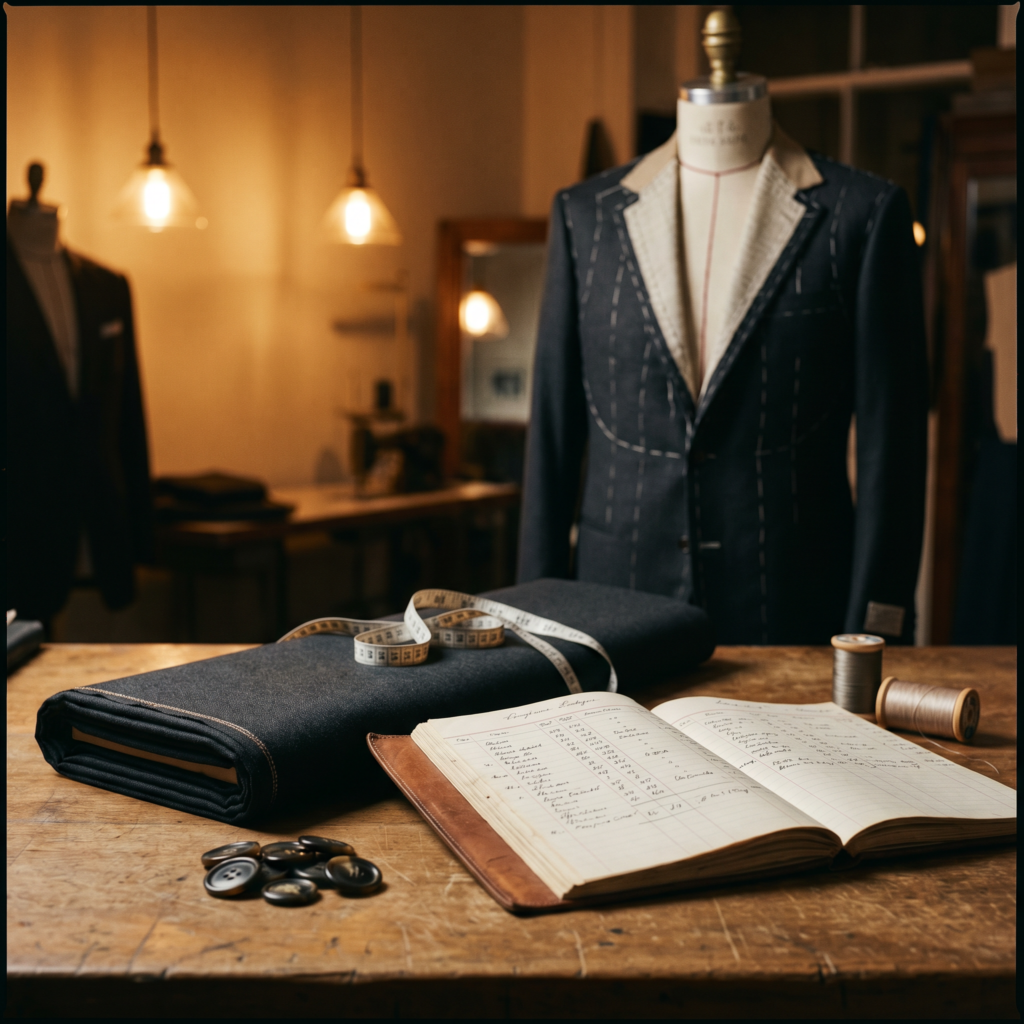
A well-made custom suit can cost more than a used car, which surprises many first-time buyers. The price is not a mystery once you see what goes into the garment. This guide walks you through the real cost drivers, from cloth and labor to construction and fittings, so you can decide if a custom suit fits your budget and your goals.
TLDR: A custom suit is expensive because most of the price goes toward cloth, skilled handwork, and a pattern made for your body. A typical Savile Row bespoke suit shows roughly a third of its retail price going straight to production, while mass-made suits cut corners on canvas, fit, and fabric to hit a low sticker price. Cost per wear is the honest way to compare options. A quality custom suit that lasts a decade often costs less per year than a cheap suit replaced every two seasons.
The sticker shock is real, and the math is worth knowing
Walk into a department store, and you can leave with a suit for $300. Walk into The Suit Doctor in Kansas City, and a custom two-piece costs significantly more. That gap looks huge until you understand what each price actually buys.
The cheap suit is built quickly on a generic pattern, with glued-together layers and entry-level cloth. The custom suit is built for one body, with better cloth, real construction, and time spent measuring, cutting, and fitting. You are paying for three things at once: the materials, the human hours, and the personal pattern that lets the suit move with you rather than fight you.
This article is the same explanation we give clients during an in-shop consultation. By the end, you will know where every dollar goes, where you can save without regret, and where saving usually backfires.
Why a cheap suit costs less than you thinkMass-made
Mass made suits use a simple formula. Brands keep fabric, labor, and trim at a small share of the retail price, then layer on freight, warehousing, marketing, returns, and store rent. Industry pricing data from JOOR shows that wholesale fashion brands typically apply a markup of 120 to 160 percent over their landed cost, which works out to a roughly 2.2 to 2.5 times multiplier at the brand level. Retailers then add their own markup on top.
That stack of multipliers is why a $300 store suit can still be profitable. The actual cloth and sewing might cost the brand under $80. To hit that low landed cost, factories use cheaper wool blends or fully synthetic cloth, fuse the inner layers with glue instead of sewing in canvas, and run the same pattern across thousands of bodies. The result fits no one in particular and tends to wear out fast.
Mid-market and premium brands work with higher multipliers, often 3 to 4 times the cost. Luxury labels can cost 5 to 10 times as much because the brand name itself carries value the customer is willing to pay for. None of this is shady. It is just how clothing pricing has worked for decades. The lesson for buyers is simple: with a mass-produced suit, a large share of the price never touches the garment.
A custom suit flips that math. Because there is no warehouse full of unsold inventory, no national ad campaign, and no department store intermediary, more of your dollar goes into the suit itself.
The six real cost drivers behind a custom suit
There are six places your money goes when you buy custom. Understanding each one helps you compare quotes honestly and spot when a price is too good to be true.
Cloth, where Italian and English mills set the floor
Fabric is the single most visible cost. A two-piece suit needs roughly 3.5 to 4.5 meters of cloth, depending on your size and the pattern. Larger frames, plaids, and stripes need more because the cutter has to match the pattern across seams. A man around 6 feet tall, in a standard size, typically measures about 3.5 meters. Bigger frames push that number toward 4.5 meters.
The cloth itself comes from a small group of historic mills. Italian mills like Vitale Barberis Canonico have been weaving since 1663 and supply many of the world’s best-known suit brands. English mills supply Savile Row. These mills do not publish retail prices, but specialty fabric retailers do, and the spread is wide.
Here is a realistic per-meter range based on what fabric merchants publicly list in 2025.
Heirloom-level cloth, very soft, less durableTypical retail per meterExample millsWhat it gets youEntry wool$30 to $60House cloth, basic blendsDurable everyday business clothMid range Italian or English$60 to $150Vitale Barberis Canonico, Reda, Holland and Sherry house booksSmooth drape, stronger color depth, longer lifePremium Super 130s to 150s$150 to $300Loro Piana, Scabal, DrapersSoft hand, refined finish, best for special occasionsLuxury and exotic$300 to $600 plusLoro Piana cashmere, vicuña blendsHeirloom level cloth, very soft, less durable
Joel and Son Fabrics, a long-standing London fabric house, publicly lists Loro Piana men’s cloth at £59.90 to £589.90 per meter, with most premium suiting and cashmere comfortably above £200 per meter. So when a tailor quotes you a higher price for a suit in a Super 150s, the cloth alone may account for $300 to $500 of that.
A higher Super number is not always better. Super 150s and above feel beautiful but wrinkle and wear faster. For a daily business suit, a Super 110s or 120s in a solid worsted wool is usually the smarter pick.
Skilled labor, the part you cannot automate
Sewing a suit is one of the last skills that machines have not replaced. There are pieces a machine can handle, but the chest canvas, lapel roll, collar, and hand-finished buttonholes still require a human touch. The Savile Row Bespoke Association sets a minimum of about 50 hours of hand labor per two-piece bespoke suit, spread across cutters, coatmakers, and trousermakers.
Public-sector analysis of Savile Row production costs provides a clear breakdown for a typical London bespoke house. Coat-making labor runs about £700 to £800 per suit. Trouser making runs £220 to £260. Pattern cutting, spread across all your fittings, runs from £200 to £300. Trimmings such as canvas, lining, silk thread, and horn buttons add another £100-£110. Add it up, and production costs around £1,420 to £1,710 per suit, which is roughly 33 percent of a typical £4,800 Savile Row retail price.
Made-to-measure suits do not require the full 50 hours of handwork, which is one reason they cost less than bespoke suits. Even so, the labor share is meaningful. According to U.S. Bureau of Labor Statistics data for tailors, dressmakers, and custom sewers, the national mean hourly wage was around $19.32 in May 2023, with the top 25 percent earning more than $21 per hour and the top 10 percent earning over $26 per hour. Experienced tailors in major metros like New York, Los Angeles, and San Francisco earn at the higher end of that range. That labor is what gives a custom suit its shape and lifespan.
Construction, the difference between a jacket that breathes and one that bubbles
This is the most important section of this article. The construction method determines how the suit drapes, how it ages, and whether it holds its shape after a few dry cleanings.
There are three construction types. Full canvas uses a layer of horsehair canvas, often blended with linen, sewn between the outer fabric and the lining. The canvas floats freely and is hand-padded, stitched into the chest and lapel. This is what gives a great suit its rolled lapel and the way it molds to your body over time. Half canvas uses real canvas in the chest and lapel, with fused construction below the chest. It is a smart middle ground, custom-made-to-measure suits, including most of what we make at The Suit Doctor.
Want to see how this plays out in a real build? Explore our our services page - it walks through fabrics, construction, and what to expect at your first appointment.
Fused construction uses heat-activated glue to bond a synthetic interlining to the outer cloth. There is no floating canvas. The vast majority of off-the-rack suits, especially under about $500, are fused. Fusing is fast, cheap, and consistent on a factory line. The downside is real. After repeated dry cleaning, the glue can break down, and the front of the jacket can bubble, ripple, or stiffen. Once that happens, the jacket cannot be repaired. It is finished.
That is a key reason longevity differs so much across price tiers, which we cover next.
Customization and fittings, where your time becomes part of the cost
A real custom suit involves a process, not a transaction. At The Suit Doctor, an initial consultation runs about an hour to ninety minutes for a single suit, longer for wedding parties or corporate groups. We take a set of detailed measurements, study how you stand, watch how the cloth falls, and talk through lifestyle, body shape, and the events you will wear it for.
A made-to-measure suit typically uses 10 to 20 measurements applied to a base block pattern. A full bespoke suit can require 30 to 40 measurements and a paper pattern drafted from scratch. Either way, you are paying for the time the tailor cannot bill to anyone else.
Then there are fittings. Made-to-measure usually involves one or two follow-up fittings before final delivery. Bespoke can require three or more. Each fitting takes a chunk of skilled labor, plus the cost of any rework if the cloth needs to be opened up and resewn. The total timeline runs roughly four to eight weeks for made-to-measure and eight to sixteen weeks for full bespoke.
The Suit Doctor offers two ways to start: free in-shop consultations in Kansas City, and mobile fittings where we come to your home or office. Mobile fittings carry a small travel fee that is credited toward your purchase, so the cost rolls into your suit if you decide to move forward.
Overhead, the part nobody likes to talk about
Even a small custom shop has real expenses that the price has to cover. Rent, insurance, lighting, sewing machines, pressing equipment, sample books from the mills, software for digital pattern making, and the cost of running a website. A shop that visits clients adds vehicle costs and travel time.
For a national online made-to-measure brand, overhead also covers warehousing, returns, and customer service teams. For a local custom shop, overhead is leaner but more concentrated. There are fewer suits to spread the rent across. That is the hidden reason a small local tailor can sometimes charge a price similar to an online brand’s and still deliver more value in the garment itself.
Longevity and cost per wear, the math that changes your mind
Here is where buyers often miss the real story. A custom suit feels expensive on day one and reasonable by year five.
Tailors widely report that a quality custom or bespoke suit, well maintained, lasts 10 to 20 years. Apsley Tailors of Savile Row, founded in 1889, states on their site that a bespoke suit typically lasts 10 to 20 years with proper care. Huntsman, founded in 1849, tells customers on its bespoke page that “you are still enjoying your garments in 20 years.” These are not guarantees. They are the patterns that those houses see across thousands of customers.
Unlike the canvassed suits described earlier in this article, off-the-rack fused suits tell a different story. Once the glue layer starts to fail, often after two to five years of regular wear and dry cleaning, the jacket cannot be saved. Tailors cannot reglue a fused front. The suit becomes a candidate for the donation pile.
Run the math on cost per wear. A $300 fused suit worn weekly for three years works out to about $1.92 per wear. A $1,500 half canvas custom suit worn weekly for ten years works out to about $2.88 per wear, and you spent every one of those wears in a suit that actually fit. Stretch that custom suit to fifteen years with care, and you are at $1.92 per wear in a far better garment. Cost per wear is the honest comparison.
Custom suit pricing tiers in 2025 and 2026
Suit pricing falls into clear tiers. Knowing where a quote sits helps you understand what you are actually buying.
Hand-drafted house patternTypical priceConstructionPattern methodFittingsEntry made to measure$500 to $900Mostly fused, sometimes half canvasAdjusted base blockOften zero, sometimes oneQuality made to measure$1,000 to $2,500Half canvas standard, full canvas at top endAdjusted base block with personal correctionsOne to twoFull bespoke (United States)$1,500 to $5,000 plusFull canvas, hand finished detailsPaper pattern drafted for youTwo to fourSavile Row bespokeAbout £6,500 and up, often $8,000 to $10,000 plusFull canvas, extensive hand sewing, around 50 hours of hand laborHand drafted house patternThree or more
Drapers, the United Kingdom apparel trade publication, reported in October 2024 that around 60 percent of Huntsman’s bespoke business comprises two-piece suits retailing at about £6,700, and Anderson & Sheppard’s bespoke suits are typically around £6,500. Top-tier Savile Row commissions for special cloth can climb past £12,000. These numbers are well above what most American buyers need to spend, but they help anchor the conversation.
The Suit Doctor sits in the quality-made-to-measure tier. We quote firm pricing during your consultation so you know exactly what your suit will cost before any commitment. Because cloth choice and construction details shift the final price, a custom quote is the most honest answer we can give.
Why a cheap suit costs more than you think
This is the section that surprises most readers. Once you account for the hidden costs of mass-made suits, the gap between cheap and custom shrinks.
The first hidden cost is alterations. Almost no off-the-rack suits fit well out of the box. A typical alteration bill for a department-store suit runs $75 to $200 for sleeves, hem, waist, and basic side-seam work. If shoulders need to be reduced or a chest needs to be opened, the bill can climb past $300, and at that point, you are doing surgery on a suit that was never built for your body. He Spoke Style, a respected menswear publication, lists realistic line-item prices that confirm this range, with sleeves featuring functioning buttonholes alone running about $150.
The second hidden cost is replacement frequency. If a fused suit lasts two to five years and a custom suit lasts ten plus, you may buy three or four cheap suits in the time you would own one custom suit. The total spend can come out roughly even, but you spent every one of those years in a worse fit.
The third hidden cost is the opportunity cost in the room you are walking into: a wedding photo, a sales call, a job interview, a funeral. The suit either helps you or it does not. A poorly fit suit pulls focus to the wrong places, wrinkles where it should drape, and reads as inattentive. That is hard to put a number on, but it is real, and most clients only realize it after they finally wear something that fits.
What this means for business, wedding, and prom suits
When you're ready to put this into practice, you can book a mobile fitting at your home or office with Brandon and get measured in person.
The honest answer is that custom is not always the right call. It depends on the occasion, the wear frequency, and the budget.
Business suits in Kansas City
If you wear a suit weekly or more, custom usually makes sense. The cost-per-wear math works in your favor, the fit holds up through long days, and the fabric choice can be tuned to the climate. Kansas City summers are humid, and winters are cold, so a tropical wool for summer and a heavier flannel or worsted for winter is a smart pairing. Most of our repeat clients build a small rotation over time, which extends the life of every suit because no single suit gets worn into the ground. For working professionals, our Kansas City business suits and made-to-measure tailoring page covers fabric choices, common cuts, and the rotation strategy in more detail.
Wedding and groomsmen suits
A wedding suit is photographed from every angle and lives in your album forever. For the groom, custom is almost always worth it. For groomsmen, the right choice depends on the group. A large wedding party with mixed body types often does better in coordinated made-to-measure suits than in matching off-the-rack suits, because you can fit each man individually while keeping the cloth, color, and details identical. Lead times matter here. A custom wedding suit takes roughly four to eight weeks for a made-to-measure fit, plus a buffer for any final fittings. Booking at least three months out is the safe move. You can see typical groom and groomsmen options on our Kansas City wedding suits and groomsmen tailoring page.
Prom suits, where the honest answer is sometimes off the rack
Prom is the one event where we will sometimes recommend against full custom. A teenager is still growing, the suit may only be worn once or twice, and a custom suit that no longer fits next year is a tough sell. For a young man who plans to keep wearing the suit through college interviews and family events, a made-to-measure suit can absolutely be worth it. For a one-night event, a sharp off-the-rack suit, properly altered, can be the smarter buy. We will tell you that during the consultation. Custom is only the right answer when it actually serves you.
Frequently asked questions
How long does the custom suit process take from start to finish? Made-to-measure typically takes four to eight weeks from the first measurement to final delivery. Full bespoke runs eight to sixteen weeks because the pattern is drafted from scratch and there are more fittings.
How many measurements do you take? For made-to-measure, expect 10 to 20 body measurements applied to a personalized base pattern. For a full bespoke, expect 30 to 40 measurements and a paper pattern drafted just for you. The Suit Doctor focuses on detailed, made-to-measure garments with a thorough measurement process.
What is the difference between made-to-measure and bespoke? Made to measure adjusts a standard base pattern to your body. Bespoke creates a brand-new paper pattern from scratch and involves more handwork and more fittings. Bespoke usually costs at least twice as much as a similar cloth, and the timeline is longer.
Is a full canvas always better than a half canvas? Not always. Full canvas gives the best drape and the longest lifespan, especially in heavier cloth. Half canvas is a smart, durable middle ground that handles dry cleaning well and keeps the price reasonable. Fused construction is the one to avoid for any suit you want to keep more than a few years.
What does a typical Suit Doctor custom suit cost? Pricing depends on the choice of cloth, construction details, and any special features. We quote firm pricing during the consultation so there are no surprises, and we are happy to share an honest range over the phone or by email before you book. Reach out through our Kansas City suit consultation and contact page for current pricing.
Do mobile fittings cost extra? There is a small travel fee for mobile fittings in the Kansas City area, which is credited toward your purchase if you move forward with a suit. In-shop consultations are free.
How do I take care of a custom suit so it lasts? Rotate it with at least one other suit so each one rests between wears. Brush it after wearing. Hang it on a wide shoulder hanger. Steam instead of iron. Dry clean only when needed, usually two to four times a year at most. Address small repairs early. A button or a loose stitch costs almost nothing to fix and prevents bigger problems later.
Key takeaways
The honest summary of everything above:
- A custom suit’s price is roughly determined by cloth, skilled labor, actual construction, customization time, overhead, and longevity, in that order of impact.
- The vast majority of off-the-rack suits are fused, which limits their lifespan and rules out major repairs once the glue fails.
- Cost per wear is the honest comparison. A quality custom suit worn for ten or more years often costs less per year than a cheap suit replaced every two seasons.
- Made-to-measure runs four to eight weeks and uses 10 to 20 measurements. Full bespoke runs for 8 to 16 weeks and uses 30 to 40 measurements.
- Custom is not always the right answer. For a one-time prom or a tight budget, a properly altered off-the-rack suit can be the smart buy.
Ready to plan your suit?
If you are weighing a custom suit for work, a wedding, or a milestone event, the next step is a conversation, not a purchase. Please tell us what you need, when you need it, and where you stand on the budget. We will walk you through cloth options, construction choices, and an honest timeline, then quote firm pricing before you commit. Book a free in-shop consultation or a mobile fitting in the Kansas City metro through our Kansas City suit consultation and contact page.
The Suit Doctor. Custom suits and made-to-measure tailoring in Kansas City since 2020.
Get measured for a suit built around how you actually live.
See what's included in a Suit Doctor build.