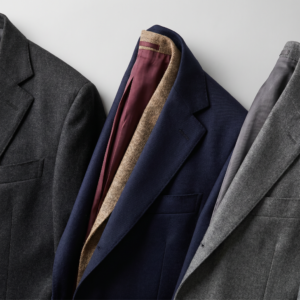












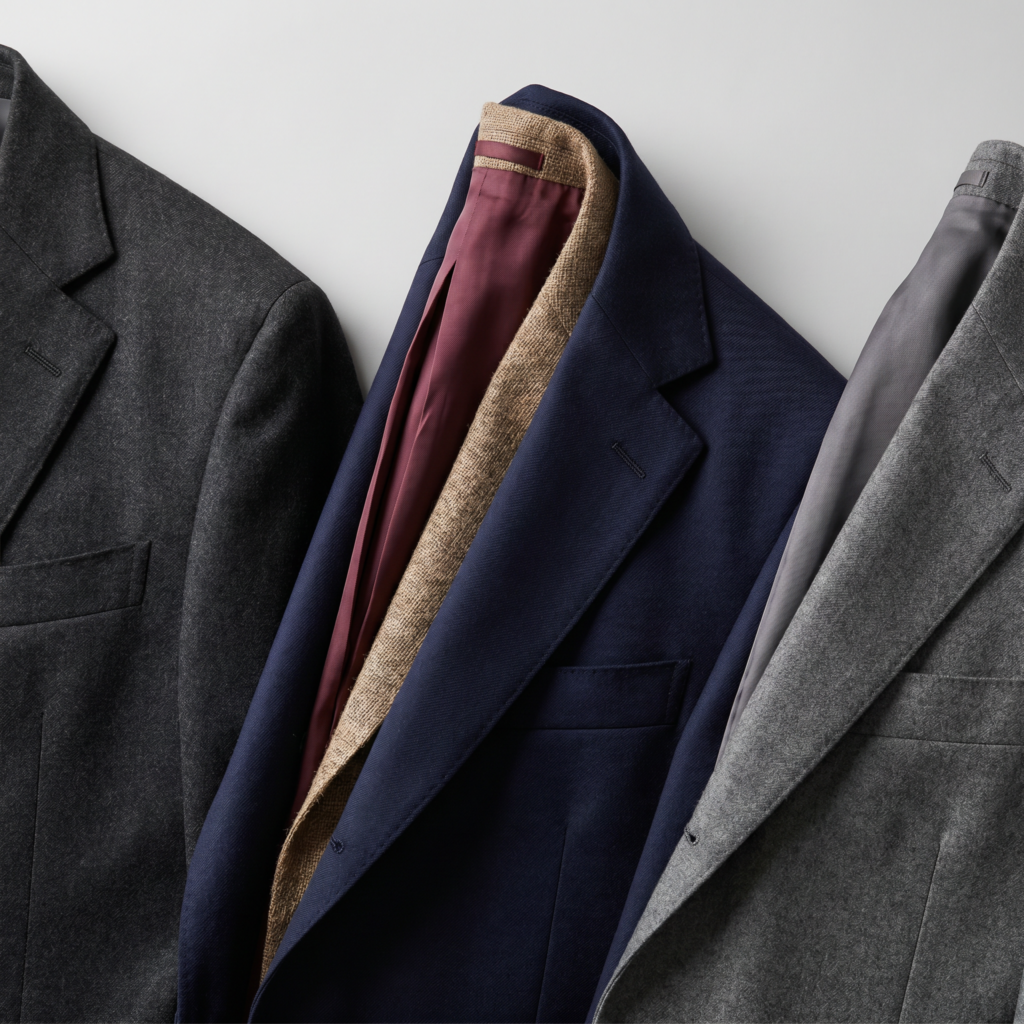
Half canvas, full canvas, and fused construction are the three ways suit jackets get their shape, and the choice quietly decides whether your jacket drapes like it was made for you or sags after a year. This guide breaks down each method, the trade-offs, and the simple in-store tests you can run before you spend a dollar.
TLDR: A suit gets its shape from a hidden layer between the outer fabric and the lining. The full canvas is sewn in from shoulder to hem and molds to your body over the years. Half canvas sews the upper chest and lapel but fuses the lower jacket, giving you most of the quality at a friendlier price. Fused construction skips the sewing and glues a synthetic interlining to the fabric, which is fast and cheap but risks bubbling. Read on for the pinch test, the lapel-roll trick, and the smart pick for your lifestyle.
You have probably owned a jacket that looked sharp on day one and turned tired within a year. The shoulders caved, the chest puckered, and no amount of pressing brought it back. That disappointment rarely comes from the fabric you can see. It comes from a layer you cannot.
Most shoppers focus on color, pattern, and price. Those things matter, but they sit on top of the part that actually decides how a suit ages. Two jackets cut from the same wool at the same price can be built in completely different ways, and only one of them will still look right in ten years.
This guide pulls that hidden layer into the open. You will learn what full canvas, half canvas, and fused construction really mean, what each one costs you in money and longevity, and the five-minute tests that let you judge any jacket before you buy it.
What Is Suit Canvas, Exactly?
Canvas in tailoring is not the rough fabric you stretch a painting over. It is a specialized interlining traditionally woven from a blend of horsehair, wool, linen, or cotton. Horsehair gives it springiness and memory. Wool and cotton add softness and breathability.
Without some internal structure, even beautiful wool flops like a beach towel. The canvas holds the chest line, supports the shoulders, and lets the lapels curve gently toward the top button. When a tailor talks about a suit “draping,” that drape comes from how the canvas, the outer cloth, and the lining work together.
Tailors stitch this canvas between the outer wool and the inner lining so it “floats” in place. Because it is sewn rather than glued, it moves with your body and slowly molds to your shape, which is why an old canvassed jacket fits its owner better year after year. Peer-reviewed research on wool fiber describes it as a multifunctional natural fiber valued for its elasticity, thermal insulation, moisture absorption, and high ignition point. Those qualities are part of why wool remains the default cloth for serious tailoring.
The shaping happens through a hand technique called pad stitching. A tailor angles the canvas, then secures it to the fabric with thousands of small diagonal stitches that lock in a curve. That curve is what gives a great lapel its three-dimensional roll instead of a flat, ironed-down crease.
Pro tip: If a salesperson cannot explain whether the canvas is sewn or glued, treat that as your first data point about the brand.
Full Canvas Construction: The Gold Standard for Daily Wear
A full canvas jacket has the floating canvas layer running all the way from the shoulder seam, through the chest, past the waist, and down to the hem. The lapels are pad stitched. Every important shaping zone is built, not bonded.
Why Full Canvas Costs More
Hand-stitching a single lapel can take hours of skilled labor. Even when modern machines assist, the canvas itself is a premium material, and the assembly cannot be rushed through a heat press. That labor is the reason a fully canvassed jacket sits at the top of the price ladder. For a deeper look at why hand construction drives cost, our breakdown of why custom suits in Kansas City cost what they do walks through every line item.
What You Get In Return
You get a jacket that breathes, drapes naturally, and gradually conforms to your posture. With proper care, a full canvas suit can last well past fifteen years and still look correct. The lapel roll stays soft. The chest never bubbles, because there is no glue to fail.
Pro tip: Full canvas is the right call if you wear a suit two or more days a week, plan to keep it long term, or want one investment piece you will tailor and re-tailor.
Half Canvas Construction: The Smart Middle Ground
Half canvas is the negotiation between craft and cost. The sewn canvas covers the upper chest and the lapels, where shape matters most. Below the chest, a thin fusible interlining is used for the jacket’s lower front.
Why So Many Modern Suits Use It
Half canvas captures most of the visual benefits of a full canvas. The lapel still rolls. The chest still has a real, sewn structure. Yet the simpler lower section reduces labor hours and material costs, which is why most quality made-to-measure programs use half canvas as their standard build.
The Trade-Offs
The bottom of the jacket is a touch less flexible than a full canvas equivalent, and the lifespan is shorter, generally ten to fifteen years rather than fifteen-plus. For most clients, those trade-offs are invisible. The suit looks crisp, photographs beautifully, and holds up to normal wear and cleaning.
Pro tip: If this is your first custom or made-to-measure suit, half canvas is almost always the right starting point. You get the look and feel of premium tailoring without the longest lead time or the highest price.
Fused Construction: When It Actually Works (and When It Does Not)
A fused jacket has no sewn canvas. Instead, a synthetic interlining is laminated to the back of the outer fabric using heat and adhesive. Textile Apex’s technical guide to fusible interlining notes that most fusible resins activate at around 110°C, while the safe ceiling is near 175°C, above which the outer cloth itself risks damage.
This is the construction behind nearly every inexpensive off-the-rack suit. By some tailoring estimates, roughly 95 percent of off-the-rack suits are fused.
The Honest Case for Fused
Fused suits are not evil. If you need a suit for one wedding, one job interview, or a single court date, a well-made fused jacket can look perfectly sharp the day you wear it. It will be lighter on your wallet and lighter on your shoulders. For someone who pulls a suit out twice a year, the math can make sense.
The Real Risk: Bubbling and Delamination
Heat and moisture are the enemies of glue. Repeated dry cleaning, summer humidity, and even an aggressive home steamer can break down the adhesive. When that happens, the outer wool separates from the interlining, and the chest develops a rippled, wavy surface called bubbling. There is no fix once it appears. The jacket is essentially done.
Industry estimates for fused suits tend to cluster around three to seven years before the construction starts to show its age. Under heavy rotation, expect the lower end of that range. Under light, occasional wear, you can stretch it.
Pro tip: Never store a fused suit in a hot car trunk or a steamy bathroom. Heat plus moisture is exactly the recipe that activates the glue in the first place.
A Three-Way Comparison Table
The differences become much easier to see when you line them up side by side. Each construction type involves a different trade-off between price, longevity, and daily performance. Here is how the three stack up across the factors that actually affect how you wear and own the suit.
| Low, only in the lower portion | Full Canvas | Half Canvas | Fused |
|---|---|---|---|
| Inner structure | Sewn canvas, shoulder to hem | Sewn canvas in upper chest and lapel, fused below | Glued synthetic interlining throughout |
| Drape and movement | Most natural, molds to body | Natural in chest, slightly stiffer below | Stiffest, does not conform |
| Lapel roll | Soft, three-dimensional | Soft, three-dimensional | Flat or pressed-looking |
| Breathability | Highest | Good | Limited |
| Typical lifespan | 15+ years | 10 to 15 years | 3 to 7 years |
| Bubbling risk | None | Low, only in lower portion | Real, especially with heat and dry cleaning |
| Relative cost | Highest | Mid-range | Lowest |
| Best for | Frequent wear, investment buyer | Most custom buyers | Occasional wear, tight budget |
For most buyers, the right choice comes down to how often you wear suits and how long you plan to keep them. Suppose you will wear the suit often, lean into canvas. If you genuinely will not, a quality fused jacket can still serve you well.
How Can You Tell Good Suit Construction in the Store?
This is the question every shopper actually wants answered. The good news is you can learn the basics in five minutes. The honest news is that no test is 100 percent reliable without cutting the jacket open. Combine the methods below for the best read.
The Pinch Test, Step by Step
The pinch test is the classic move and the easiest to do without looking strange in a fitting room.
- Unbutton the jacket and find the lower front panel, a few inches below the bottom buttonhole.
- Use your thumb and forefinger on the outside to pinch just the outer fabric.
- With your other hand inside the jacket, pinch just the lining at the same spot.
- Gently pull the two pinches apart. You are trying to feel for a distinct third layer floating between them.
If you feel a clear, independent middle layer, the jacket has a full canvas in that area. If the two layers feel glued together with nothing between them, the lower section is fused. Menswear writer Derek Guy of Put This On flags an important limitation here: the pinch test cannot distinguish between half-canvas and fully fused, because the area below the second button is fused in both builds.
So the pinch test reliably confirms a full canvas, but it cannot distinguish a half canvas from a fused one on its own. You need a second signal.
Read the Lapel Roll
A pad-stitched canvas lapel has a soft, three-dimensional curve from the collar down to the top button. It looks like a gentle wave, not a sharp fold. A fully fused lapel often looks pressed flat, like a piece of paper that has been creased and ironed.
Run your fingers behind the lapel. On a quality canvassed jacket, you can sometimes feel tiny pad stitches on the underside. On a fused lapel, the back side feels uniformly stiff and lifeless.
Compare the Chest to the Sleeve
Pinch the sleeve fabric between your fingers and feel how thick it is. Sleeves are never canvassed, so this gives you a baseline for the outer cloth alone. Then pinch the chest. If the chest feels dramatically thicker and stiffer than the sleeve in a uniform, plasticky way, you are probably feeling fused interlining. If it feels thicker but supple, with a layer that shifts independently, that is canvas.
Pro tip: Do all three checks on the same jacket. Any single test can mislead, but together they almost always tell the truth.
Three Questions Worth Asking Any Salesperson
Most retail salespeople do not know how the suits in their own store are built. That is not a knock on them; it is just the reality of the market’s volume side. A few direct questions will quickly reveal who you are dealing with.
- Is the canvas sewn in or fused? A confident, specific answer is the green flag.
- Is the lapel pad stitched, and is it canvas or fusible behind the roll? This distinguishes true half-canvas builds from “half canvas with a fused lapel.”
- What is the realistic lifespan and care routine for this construction? An honest answer about dry-cleaning frequency and storage shows that the seller actually understands the product.
If you hear vague language, hedging, or marketing words instead of construction terms, take that as your answer and shop somewhere else.
Real-World Scenarios: Picking the Right Construction for Your Life
Construction choices should be driven by how you actually wear suits, not by what looks best on a spec sheet.
The Business Professional in Rotation
If you wear a suit three to five days a week, fused will not survive your schedule. Half of the canvas is the floor. The full canvas is the ceiling. Build a small rotation, rest each jacket for twenty-four hours between wears, and you will look sharper and spend less on replacements over a decade.
The Groom Planning a Wedding
A wedding suit gets photographed from every angle and worn for ten or more hours straight. The lapel roll and chest line will show in every picture. Half canvas is the sweet spot for most grooms, with full canvas reserved for those who plan to wear the jacket regularly afterward. Our complete tuxedo and suit guide for Kansas City weddings walks through fabric, lapel, and color choices that pair with each construction.
The Prom Attendee or One-Event Wearer
For a single night under stage lights and dance-floor heat, a sharp, fused suit can absolutely deliver. The key is to make sure the fit is right and that cleaning happens carefully afterward so the jacket survives for future events. If prom turns into homecoming, graduation, and three weddings, consider trading up to half canvas the next time around.
The Style-Conscious Investor
If you think about clothing the way you think about other long-term purchases, full canvas is the only conversation that makes sense. The cost-per-wear math gets very friendly over fifteen years, and a properly maintained canvassed jacket can be altered multiple times as your body and style evolve.
Frequently Asked Questions
Is a fused suit ever worth buying? Yes, with caveats. If you genuinely wear a suit only a few times a year and budget is the main constraint, a well-cut fused suit can look great the day of the event. Just plan to replace it sooner and avoid aggressive dry cleaning. For anyone who wears suits regularly, half-canvas or full-canvas is the smarter long-term investment.
What does “bubbling” actually look like? Bubbling shows up as small ripples, waves, or puckers on the chest or lapel of a fused jacket. The outer wool has separated from the glued interlining underneath. Once it appears, no tailor can press it out for good. It is the most common failure mode for fused suits and the biggest argument for canvas.
Can a tailor convert a fused suit into a canvassed one? No, not in any practical sense. The construction is locked in at the factory. Alterations can adjust fit, but they cannot rebuild the internal skeleton. If construction quality matters to you, it has to be right from day one.
Does made-to-measure always mean canvas? Not automatically. Some made-to-measure programs use fused construction to keep prices low. Always ask specifically whether the build is full-canvas, half-canvas, or fused. A reputable program will answer plainly, and our team is happy to walk you through every option during a no-pressure consultation.
Is a full canvas worth the upgrade from a half canvas? For frequent wearers, yes. The lifespan jump and the softer drape over time make a full canvas an excellent investment. For occasional wearers, half canvas delivers most of the visible benefit at a lower price. There is no wrong answer, only the right answer for your rotation.
How do I care for a canvassed suit? Hang it on a wide, contoured wooden hanger between wears. Brush it with a soft garment brush after each wear to lift dust—dry clean only when needed, not on a schedule. Steam gently to refresh between cleanings. Treated this way, a canvassed suit will outlast several fused jackets.
Do all expensive suits use canvas? Most do, but not all. Some designer labels charge premium prices for fused construction, relying on brand name rather than build quality. The pinch test, the lapel-roll check, and a direct question about construction protect you here regardless of price tag.
Key Takeaways
- The skeleton beats the skin. Construction matters more than color or pattern for how a suit looks and lasts.
- Full canvas is the long game. Sewn from shoulder to hem, it molds to you and can serve for fifteen years or longer.
- Half canvas is the sweet spot. Most quality custom and made-to-measure suits use it because it delivers the lapel roll and chest line at a smarter price.
- Fused has a place, but it is narrow. Fine for occasional wear, risky for daily rotation, and vulnerable to bubbling from heat and dry cleaning.
- Testing takes five minutes. Combine the pinch test, the lapel-roll check, and the sleeve-to-chest comparison for a reliable read.
- Ask, then verify. A salesperson who answers construction questions with specifics shows you that the brand cares about how the suit is built.
Ready to Feel the Difference Yourself?
You now understand what most suit shoppers never learn: the hidden layer inside a jacket decides almost everything about how it looks, moves, and lasts. Knowing how to read construction is the single biggest upgrade you can make as a buyer.
When you work with our team, you get:
- A straight answer about whether your jacket is full canvas, half canvas, or fused
- A consultation that matches construction to how you actually wear suits
- Made-to-measure and custom programs built around real lifespan, not just first-day looks
- Local Kansas City service from people who care about the fit you walk out with
Whether you are dressing for daily work, your wedding, prom, or the next decade of your career, the right construction makes the difference between a suit you tolerate and one you reach for. Book a fitting or consultation with our Kansas City tailoring team, and we will help you choose the build that fits your life.
The Suit Doctor | Custom and Made-to-Measure Suits for Men Who Take Their Look Seriously.