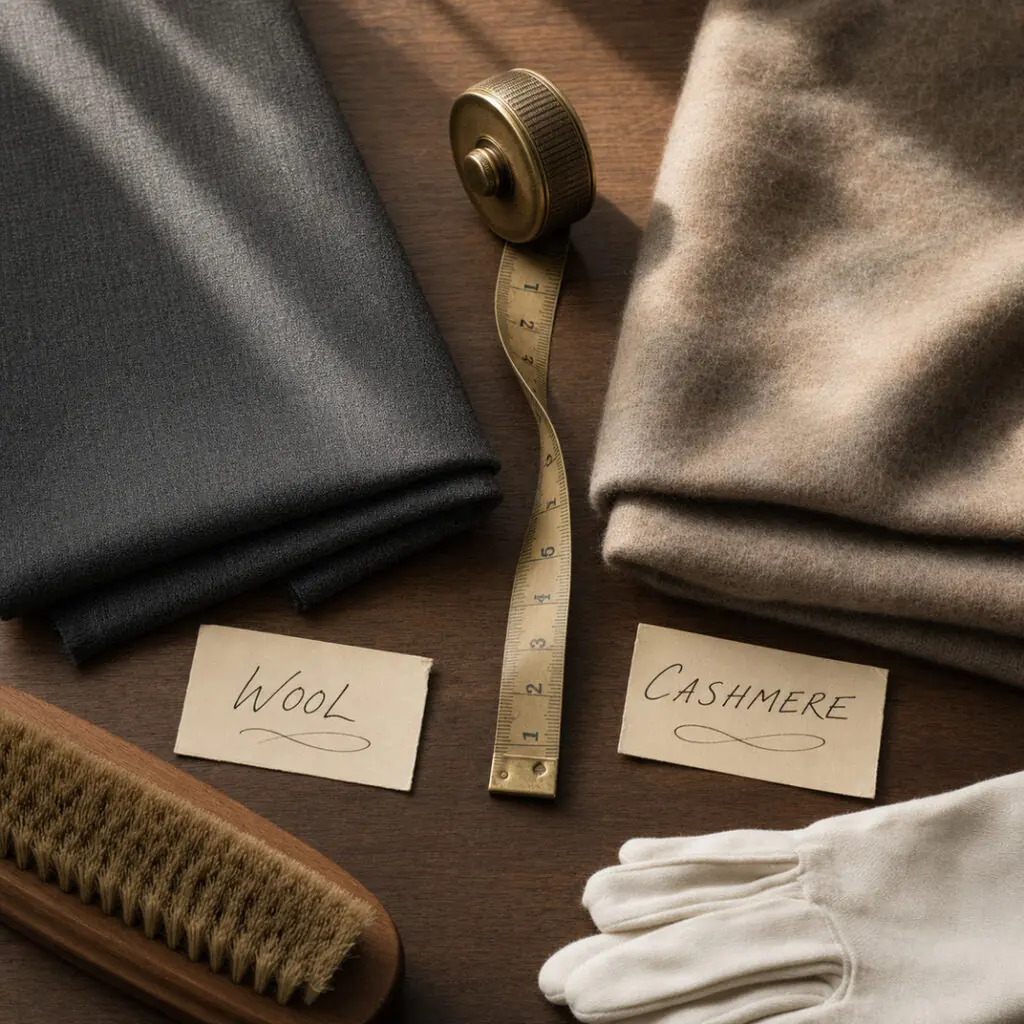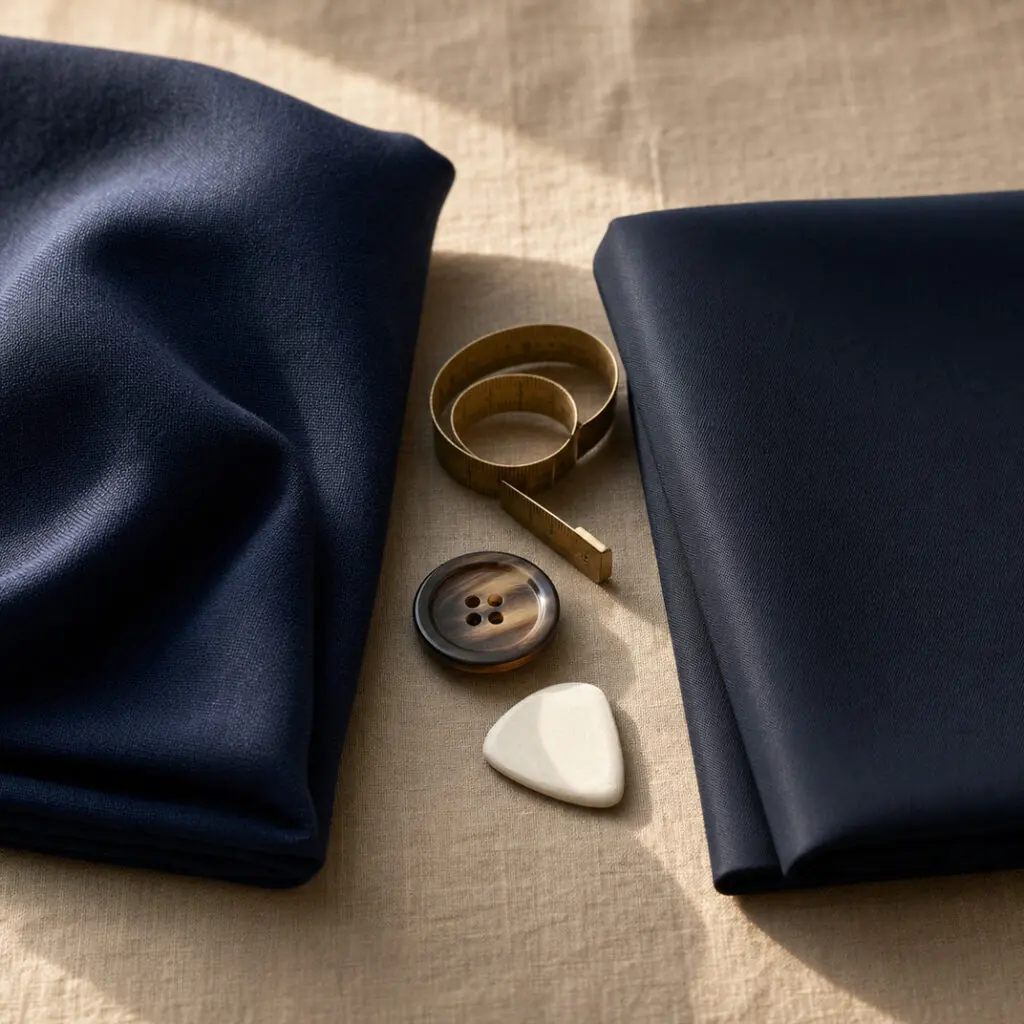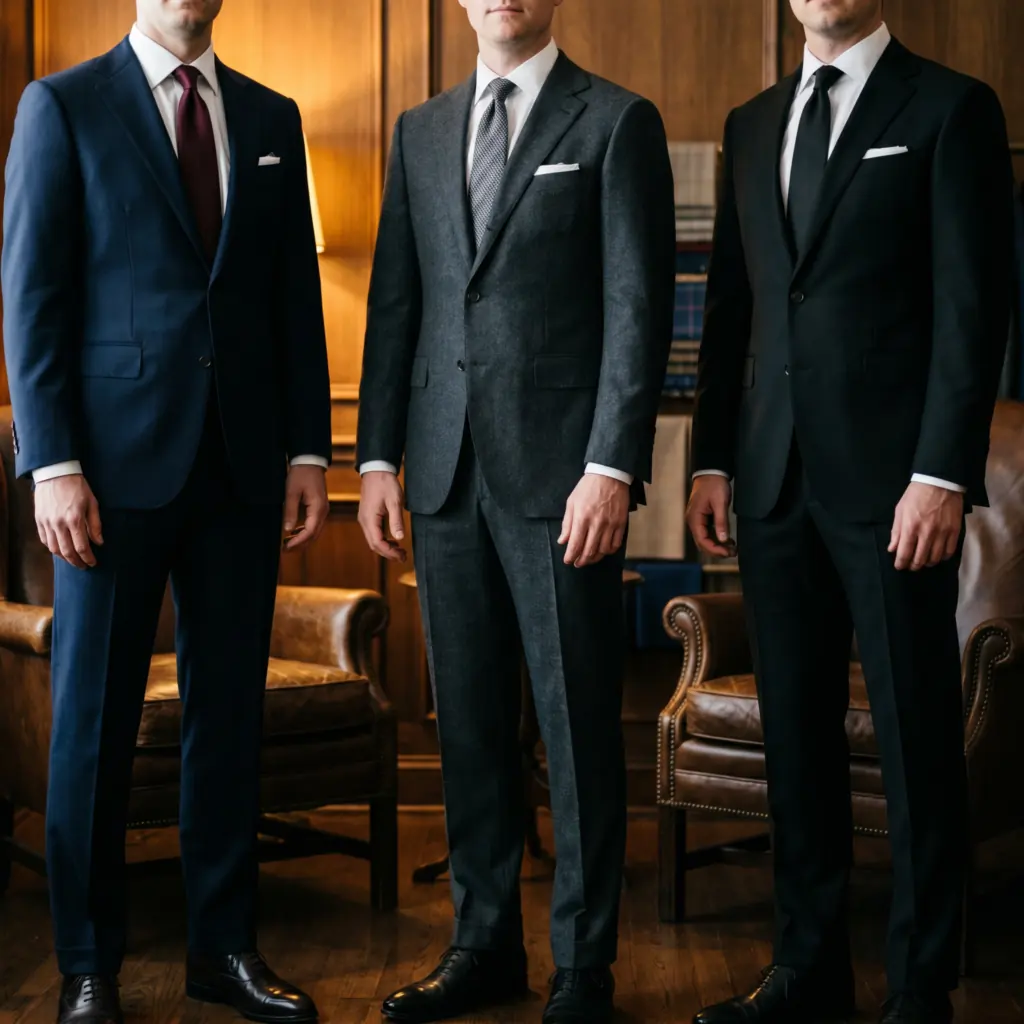
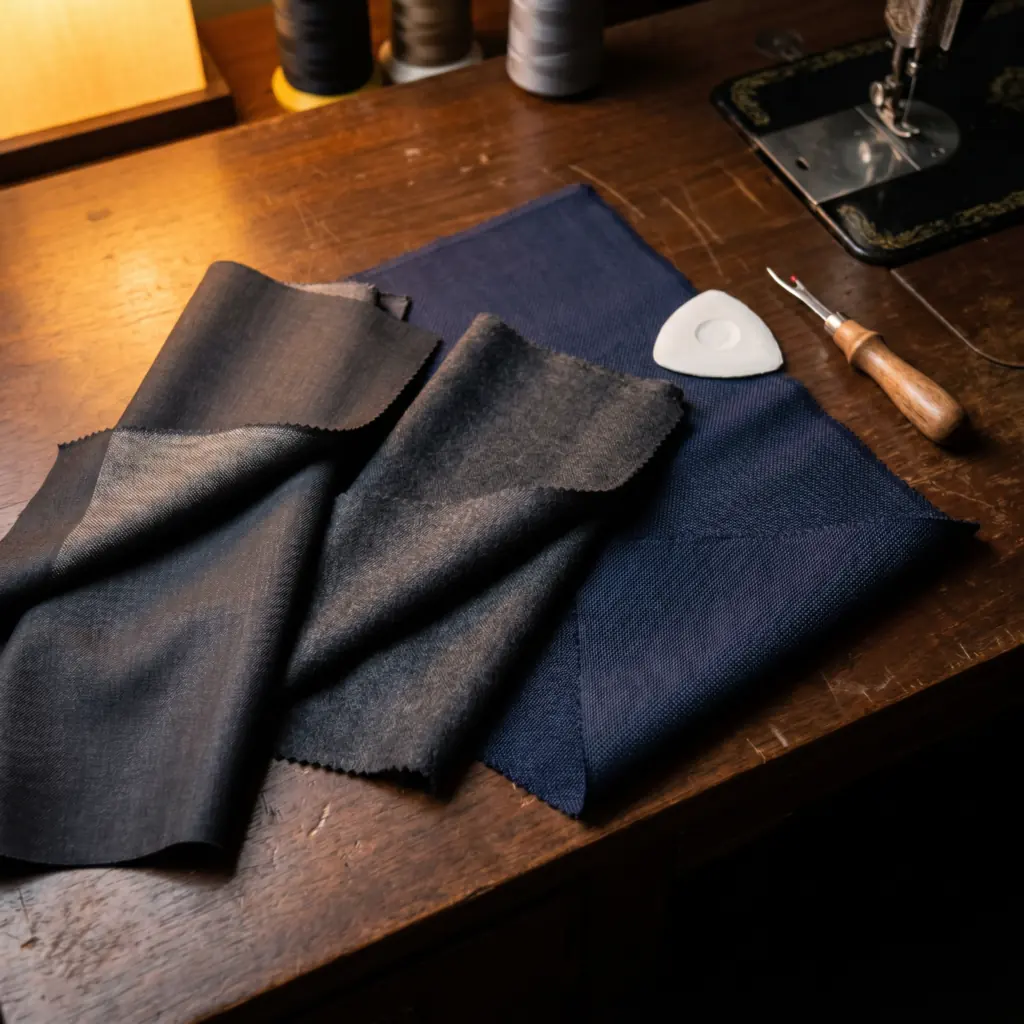
Pick up a worsted wool suit jacket, a flannel suit jacket, and a tropical wool suit jacket side by side, and you will immediately feel the difference. One is crisp and smooth. One is soft and warm. One is almost lighter than it looks. All three are wool. All three are correct choices for specific situations. The challenge is knowing which one is right for your work environment, your climate, and how you actually use your suits.
This guide breaks down the three most common business suit materials, explains exactly how each one performs, and gives you a clear framework for choosing the right fabric for your professional wardrobe in Kansas City.
TLDR: Worsted wool is the year-round workhorse for most professionals. Flannel is the superior choice for fall and winter if you want warmth and a richer look. Tropical wool works for Kansas City’s warmest months. Get the weight, weave, and season right and you will never be uncomfortable or underdressed in a suit again. Read the full guide to understand exactly why.
Why Fabric Choice Matters for a Business Suit
Most men focus heavily on color and cut when choosing a business suit. Fabric gets less attention, but it has more direct impact on how the suit performs day to day.
Fabric determines how warm or cool you feel. It determines whether your suit looks sharp at 8 a.m. and again at 5 p.m. or whether it has creased beyond recovery by noon. It determines how long the suit lasts with regular wear. And it determines whether the garment holds its structure and silhouette across a full business year or needs to be replaced in two years.
Kansas City has a genuinely variable climate. Summers reach the high 90s with significant humidity. Winters produce consistent cold with occasional temperatures below 10 degrees Fahrenheit. Spring and fall can swing 40 degrees within a week. A professional who wears suits regularly needs to think about fabric strategically across the full year, not just for one season.
The three fabrics in this guide, worsted wool, flannel, and tropical wool, cover that full range when chosen correctly.
Worsted Wool: The Foundation of Every Professional Wardrobe
Worsted wool is the most important fabric in menswear. If you own only one suit or are building a wardrobe for the first time, this is where you start.
What Makes Worsted Wool Different
The term “worsted” refers to a specific manufacturing process, not a single fabric type. Worsted wool begins with long-staple wool fibers, typically between 7 and 10 centimeters in length. These fibers are combed to align them parallel before spinning, which removes shorter fibers and creates a smooth, even yarn. That yarn is then woven tightly into cloth.
The result is a fabric with a smooth surface, minimal texture, sharp clean lines, and excellent resistance to wrinkling. Compared to flannel, which uses shorter, softer fibers without this combing process, worsted wool has a refined, crisp appearance and holds its structure better through a long day of wear.
Why Worsted Works for Business
The smooth surface of worsted wool reads as formal and polished in business settings. It holds a pressed crease in the trouser leg. It drapes cleanly from the shoulder without bunching or sagging. It responds well to pressing and cleaning. These are the properties that make worsted wool the standard material for business suits across virtually every professional industry.
Worsted wool also handles Kansas City’s climate transitions better than any other fabric. A mid-weight worsted in the 270 to 300 GSM range is genuinely comfortable across spring, fall, and in climate-controlled buildings year-round. For most professionals, this single weight serves as their everyday suit fabric.
Super Numbers: What They Mean and What to Buy
You will see worsted wool suits described with a “Super” number: Super 100s, Super 110s, Super 120s, Super 130s, and beyond. These numbers refer to the fineness of the individual wool fibers, measured in microns. A lower Super number indicates thicker, more durable fibers. A higher Super number indicates finer, softer fibers.
Super 100s: Approximately 18.75 microns. Durable, resilient, and appropriate for regular wear. The correct choice for a suit you plan to wear frequently.
Super 110s: Approximately 18.25 microns. Slightly finer and softer than Super 100s, still durable enough for daily professional use.
Super 120s: Approximately 17.75 microns. Noticeably softer and finer in appearance. Appropriate for suits you wear regularly but with some care. The upper end of what most professionals should consider for a workhorse suit.
Super 150s and above: Extremely fine and luxurious, but significantly more delicate. These fabrics require more careful handling and dry cleaning. They do not belong in a suit you plan to wear twice a week.
For Kansas City professionals building a business wardrobe, Super 100s to Super 120s in the 270 to 310 GSM range is the reliable target. Fine enough to look polished. Durable enough to handle a real work schedule.
Best Colors in Worsted Wool
Midnight navy and charcoal grey are the foundational choices. Both photograph well, pair with the widest range of shirts and ties, and work across the full spectrum of professional occasions. Medium grey is the correct choice for the third suit in a coordinated wardrobe.
Flannel: The Superior Cold-Weather Choice
If worsted wool is the year-round foundation, flannel is the fabric that makes fall and winter suit wearing genuinely enjoyable rather than merely functional.
What Makes Flannel Different
Flannel is produced using a different manufacturing process than worsted. It uses shorter wool fibers, typically processed with a technique called milling or fulling, where the woven cloth is beaten and agitated until the surface fibers break down into a soft, slightly fuzzy nap. This surface treatment is what gives flannel its distinctive matte, textured appearance and its warmth.
There are two types of flannel worth understanding:
Woollen flannel uses carded (loosely aligned) shorter fibers. It is the traditional, heavier flannel: softer, warmer, and more textured. This is the flannel that most tailors and menswear experts mean when they recommend flannel for a suit.
Worsted flannel uses combed longer fibers, then applies a lighter version of the milling process. The result is a finer, lighter flannel with better drape and more year-round versatility. It retains some of flannel’s softness and texture but without the same warmth or visual weight.
For a fall or winter business suit in Kansas City, woollen flannel in the 290 to 340 GSM range is the correct choice.
Why Flannel Works for Cold-Weather Business
The brushed surface of flannel traps air against the body, creating natural insulation that a smooth worsted cannot replicate at the same fabric weight. In practice, this means a flannel suit is perceptibly warmer than a worsted suit at comparable weights. For a Kansas City professional who walks from a parking lot to an office building in January, that warmth makes a meaningful difference in comfort.
Flannel also has a visual richness that photographs particularly well. The matte surface absorbs light rather than reflecting it, which creates a deep, saturated appearance that charcoal grey and midnight navy flannels are especially known for. In the subdued light of fall and winter, flannel suits simply look better than their worsted counterparts.
The Trade-Offs
Want to see how this plays out in a real build? Explore our business suits page - it walks through fabrics, construction, and what to expect at your first appointment.
Flannel creases more easily than worsted wool. It also shows more wear over time, since the surface fibers can pill or thin with regular friction. Flannel suits are best rotated with other garments rather than worn day after day.
Flannel is also a warm fabric. It is not appropriate for Kansas City’s spring or summer conditions, and even in climate-controlled buildings, a heavy flannel can feel warm during a long afternoon. Think of flannel as the October through March fabric for this region.
Best Colors in Flannel
Charcoal flannel is one of the most powerful combinations in professional menswear. The depth of charcoal in a matte flannel texture creates a visual gravity that no other fabric quite matches. Mid-grey flannel is an excellent choice for a slightly less formal but still polished look. Navy flannel at a deep midnight shade works beautifully for the professional who wears navy as their primary suit color.
Flannel also handles subtle patterns, such as herringbone weaves and fine chalk stripes, particularly well. These patterns add visual interest without compromising the seriousness of the fabric’s weight and formality.
Tropical Wool: The Summer Professional’s Fabric
Kansas City summers are genuinely challenging for professional dress. Temperatures from June through August regularly reach the high 80s and 90s with significant humidity. In those conditions, a standard worsted wool suit becomes uncomfortable quickly.
Tropical wool is the correct solution for professionals who need to wear suits in warm weather. Our Kansas City summer suit fabric guide goes deeper on warm-weather options.
What Makes Tropical Wool Different
Tropical wool is a lightweight worsted fabric specifically designed for warm-weather wear. The key differences from standard worsted wool are:
Lower weight: Tropical wool typically falls in the 180 to 230 GSM range, significantly lighter than the 270 to 310 GSM of a year-round worsted. This reduced weight means less fabric against the body and less heat retention.
Open weave: Tropical wool uses a looser weave structure that allows air to circulate through the fabric. Standard worsted wool has a tighter, denser weave that traps more air and provides more insulation. Tropical wool’s open weave allows airflow, which is essential for comfort in humid Kansas City summers.
High twist yarn: Many tropical wool fabrics use a high-twist yarn construction, where the fibers are spun with more rotations per inch. High-twist yarns produce a fabric that is more resistant to wrinkling, which is particularly useful in humid conditions where standard fabrics can crease heavily.
How Tropical Wool Performs
Wool, including tropical wool, has a natural advantage over cotton, linen, and synthetics in warm weather because of the crimp structure of wool fibers. Unlike flat synthetic or cotton fibers, wool fibers have a natural wave that creates small air pockets throughout the fabric. These air pockets both allow airflow and pull moisture away from the body, which is why wool can feel cooler than lightweight cotton in humid conditions.
The trade-off for tropical wool is structure. A fabric this lightweight does not hold its shape with the same precision as a heavier worsted. Tropical wool suits are better suited for business-casual environments, summer client lunches, and warmer-weather professional events than for high-formality settings where a suit needs to look immaculate at the end of an 8-hour day.
A tropical wool suit should be partially or minimally lined to preserve breathability. A fully lined tropical wool suit negates much of the breathability advantage.
Best Colors in Tropical Wool
Navy and medium grey are the most practical choices for a tropical wool business suit. Both colors work in warm-weather professional environments without looking seasonally inappropriate. Lighter colors such as stone, tan, or light grey work in less formal summer business settings and for outdoor events.
Choosing the Right Fabric for Your Situation
- Mid-weight worsted: Best Season (KC): Year-round; Target GSM: 270 to 310; Formality Level: High; Durability: Excellent
- Wool flannel: Best Season (KC): Oct to Mar; Target GSM: 290 to 340; Formality Level: High; Durability: Good (rotate well)
- Tropical wool: Best Season (KC): May to Sep; Target GSM: 180 to 230; Formality Level: Medium-High; Durability: Good (lightweight care)
- Heavyweight worsted: Best Season (KC): Nov to Feb; Target GSM: 320 to 380; Formality Level: Very High; Durability: Excellent
If you are building a professional wardrobe from scratch, the correct sequence is:
First suit: Mid-weight worsted wool in midnight navy. This handles the widest range of seasons, occasions, and professional environments.
Second suit: Charcoal grey, also in mid-weight worsted or wool flannel depending on your primary working season. If you work in a cold office environment or have frequent outdoor exposure in fall and winter, choose flannel. If your primary environment is climate-controlled year-round, mid-weight worsted in charcoal is more practical.
Third suit: Choose based on what your first two suits do not cover. If you need a summer option, this is the right moment for a tropical wool in navy or grey. If your wardrobe is already well-served for warmer months, a medium grey or subtle pattern in mid-weight worsted rounds out the three-suit foundation.
Canvas Construction and Its Relationship to Fabric
The internal structure of your jacket matters as much as the external fabric. Canvas construction, where an internal layer of horsehair and linen canvas is stitched (not glued) to the outer fabric, gives the jacket its shape and helps it mold to your body over time.
Full-canvas construction is most important for the heavier, more structured fabrics: mid-weight and heavyweight worsted wools, and wool flannel. These fabrics are meant to drape and hold their shape, and the canvas layer is what enables that performance over years of wear.
For tropical wool suits, a half-canvas or even a minimal internal structure is sometimes appropriate, since the fabric’s primary advantage is lightweight breathability. A heavy canvas layer can counteract the fabric’s lightness.
When you invest in a properly constructed suit, the canvas layer is part of that investment. It is what separates a suit that still looks sharp after three years from one that has lost its structure after twelve months.
Pro Tips for Kansas City Professionals
Tip 1: Rotate your fabrics by season. Wearing a flannel suit in July is uncomfortable. Wearing a tropical wool in January makes you cold. Build your wardrobe with seasonal intention and you will always be comfortable.
Tip 2: For tropical wool suits, choose a partial or unlined construction and invest in proper storage. Lightweight fabrics are more susceptible to deformation on cheap hangers. Wide wooden suit hangers preserve the shoulder shape.
When you're ready to put this into practice, you can book a mobile fitting at your home or office with Brandon and get measured in person.
Tip 3: When choosing between Super numbers in worsted wool, let your wearing frequency guide the decision. A suit worn twice a week benefits more from Super 100s durability than Super 130s softness. A suit worn once a month for special occasions can handle the more delicate finer counts.
For personalized guidance on which fabric is right for your specific profession, office environment, and wardrobe goals in Kansas City, see our Kansas City custom business suit consultation or schedule a Kansas City fitting appointment and we will walk through every option with real fabric samples.
Frequently Asked Questions
Q: Is worsted wool really warm enough for Kansas City winters?
A mid-weight worsted wool at 270 to 310 GSM is fine in climate-controlled offices. If you spend significant time outdoors in winter or wear your suit without a heavy overcoat, move up to a heavyweight worsted at 320 GSM or above, or switch to wool flannel for your winter suits.
Q: How do I know if a suit is truly worsted versus another wool type?
Worsted wool has a smooth, clean surface with minimal texture or fuzz. It feels slightly crisp to the touch. Flannel has a soft, brushed surface with visible texture. Tweed has a rough, nubby hand feel. If you cannot assess it by touch, check the fabric label or ask your tailor.
Q: Can I wear a tropical wool suit in a formal business meeting?
Yes, if the color and style are appropriate. A well-fitted navy or charcoal tropical wool suit reads as professional and polished in a formal meeting. The limitation is that tropical wool suits look their best in moderate temperatures. In a very cold, highly formal environment, the lightweight fabric and less structured drape can look slightly less authoritative than a mid-weight worsted.
Q: How often should I dry clean a worsted wool suit?
As infrequently as possible. Dry cleaning is hard on wool fibers and should be reserved for genuine staining or odor that cannot be addressed through airing. Between cleanings, use a soft brush to remove surface dirt after each wearing, hang on a wide wooden hanger, and allow at least 24 hours of rest between wearings. A suit rotated properly and brushed regularly needs dry cleaning only two or three times per year.
Q: Is flannel appropriate for a job interview?
Yes, in fall and winter. A well-fitted charcoal flannel suit is an excellent interview choice. It reads as serious, polished, and confident. In spring and summer, switch to a mid-weight worsted for the same occasion.
Q: What is the best fabric for a first professional suit?
Mid-weight worsted wool at 270 to 300 GSM in midnight navy or charcoal grey. This fabric covers the most occasions, the most seasons, and the most professional environments. It is also the most durable choice for a suit that will see regular use. Start here and add flannel and tropical wool as your wardrobe grows.
Q: Does fabric choice affect how long a suit lasts?
Significantly. A durable mid-weight worsted in Super 100s-110s will outlast a Super 150s suit by years under regular wearing conditions. Heavier, tighter-woven fabrics are more resistant to abrasion and pilling. The trade-off is that they are slightly less soft. For a suit you wear regularly, durability is the more important investment.
Key Takeaways
- Worsted wool is the foundation: Every professional wardrobe starts with mid-weight worsted wool. It works year-round, holds its shape, and handles every business occasion correctly.
- Super 100s-120s is the professional sweet spot: Fine enough to look polished, durable enough for regular wear. Avoid Super 150s and above for frequently worn suits.
- Flannel is the winter upgrade: For October through March in Kansas City, wool flannel at 290 to 340 GSM delivers warmth, visual richness, and a refined appearance that worsted cannot match at the same weight.
- Tropical wool solves the summer problem: 180 to 230 GSM tropical wool with an open weave and partial lining is the correct fabric for Kansas City’s warm, humid summers.
- Build by season: Start with a year-round mid-weight worsted, add a flannel for winter, and add a tropical wool for summer as the wardrobe grows.
- Canvas construction protects the investment: Full or half-canvas construction keeps your fabric performing correctly over years of wear.
- Rotate all wool suits: No wool suit should be worn on consecutive days. Rest is essential for the fibers to recover their structure and for the garment to last.
Ready to Choose the Right Fabric for Your Wardrobe?
You now understand the difference between worsted wool, flannel, and tropical wool, why each one belongs in a specific context, and how to build a Kansas City professional wardrobe that works across every season and situation.
The Suit Doctor offers:
- Made-to-measure business suits in premium mid-weight and heavyweight worsted wools
- Wool flannel options for fall and winter in charcoal, navy, and herringbone patterns
- Tropical wool options for warm-weather professional use
- Expert fabric selection with real samples at your home or office
- Canvas construction options for long-lasting structure and performance
Ready to feel the difference between these fabrics in person and have an expert guide your decision?
Reach out to schedule your Kansas City custom suit consultation and we will bring everything to you.
The Suit Doctor | Custom and Made-to-Measure Suits for Men Who Take Their Look Seriously.
Get measured for a suit built around how you actually live.
Suits built for boardrooms, travel, and long days on your feet.