Every man eventually faces this question. You are buying a suit, or your first suit, or adding a third suit to a wardrobe that already has two. You have narrowed the decision to navy, charcoal, or black. All three look sharp in the store. All three feel like the right choice in the moment.
But only one is actually right for you. And the answer depends on a framework most men have never been given.
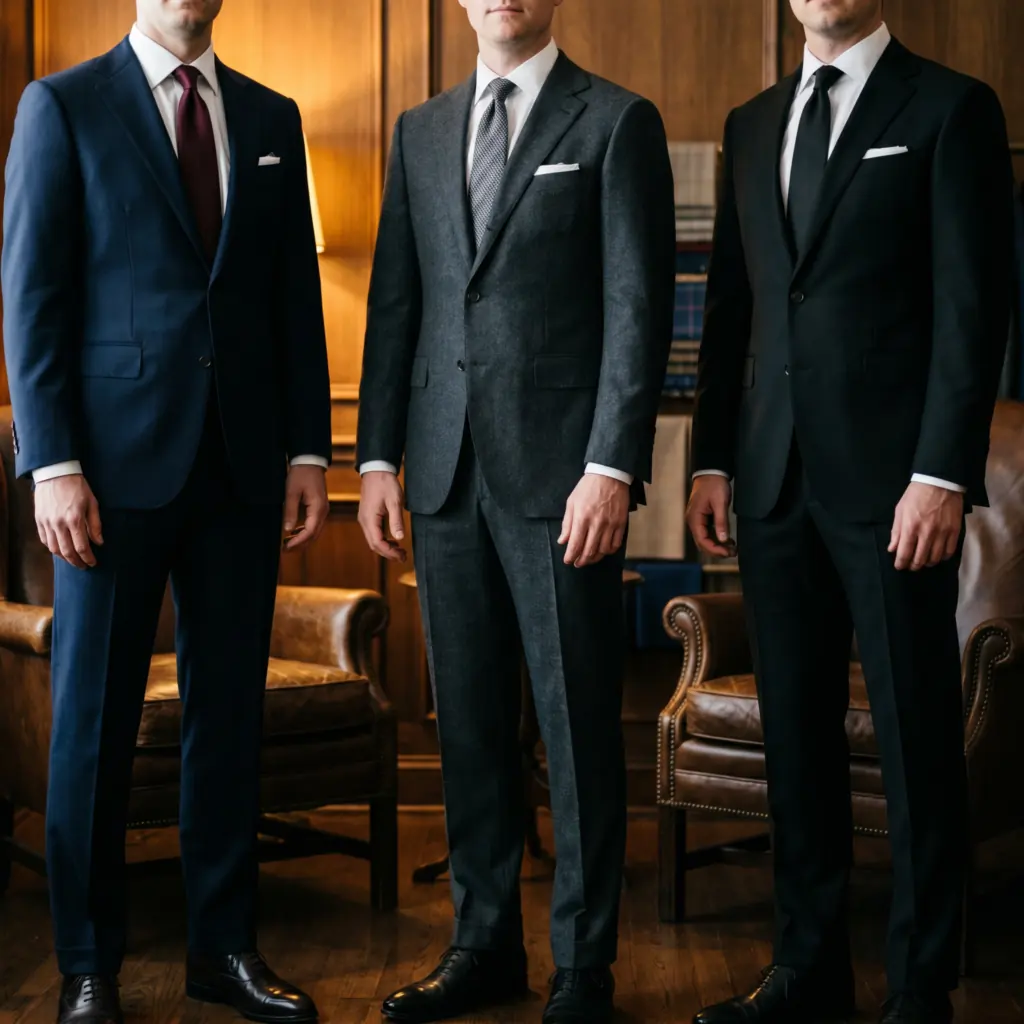
This guide compares navy, charcoal, and black suits across every dimension that matters: versatility across occasions, wearability at weddings as both a groom and a guest, performance in professional settings, interchangeability as separates, and how each color works across different complexions and seasons. By the end, you will have a clear recommendation and the reasoning behind it.
TLDR: Navy is the most versatile suit color for most men. Charcoal is the most formally authoritative choice for business-first professionals. Black is the most restricted in daily use and belongs primarily in black-tie contexts. Read on for the full breakdown.
Why Suit Color Matters More Than Most Men Think
A suit that fits well in the wrong color still underperforms. Color is not just aesthetic. It determines which shoes work with it, which shirts it pairs with, whether it reads as formal or casual, whether it can be worn across multiple occasions or only one, and whether the jacket can work as a separate piece without the matching trousers.
A man who buys navy first and charcoal second has a wardrobe that covers approximately 90% of all suit-wearing occasions in his life. A man who buys black first is starting with the most restricted option. These are not abstract style opinions. They are practical conclusions drawn from how these colors perform across real situations.
Navy: The Most Versatile Suit Color
Navy is the first suit color most experienced tailors and menswear professionals recommend, and that recommendation is nearly universal.
Why Navy Works Everywhere
Navy’s core advantage is range. It works at business meetings, client lunches, job interviews, cocktail parties, weddings, funerals, and dinner reservations without reading as wrong for any of them. It walks the line between formal and approachable in a way that no other color manages.
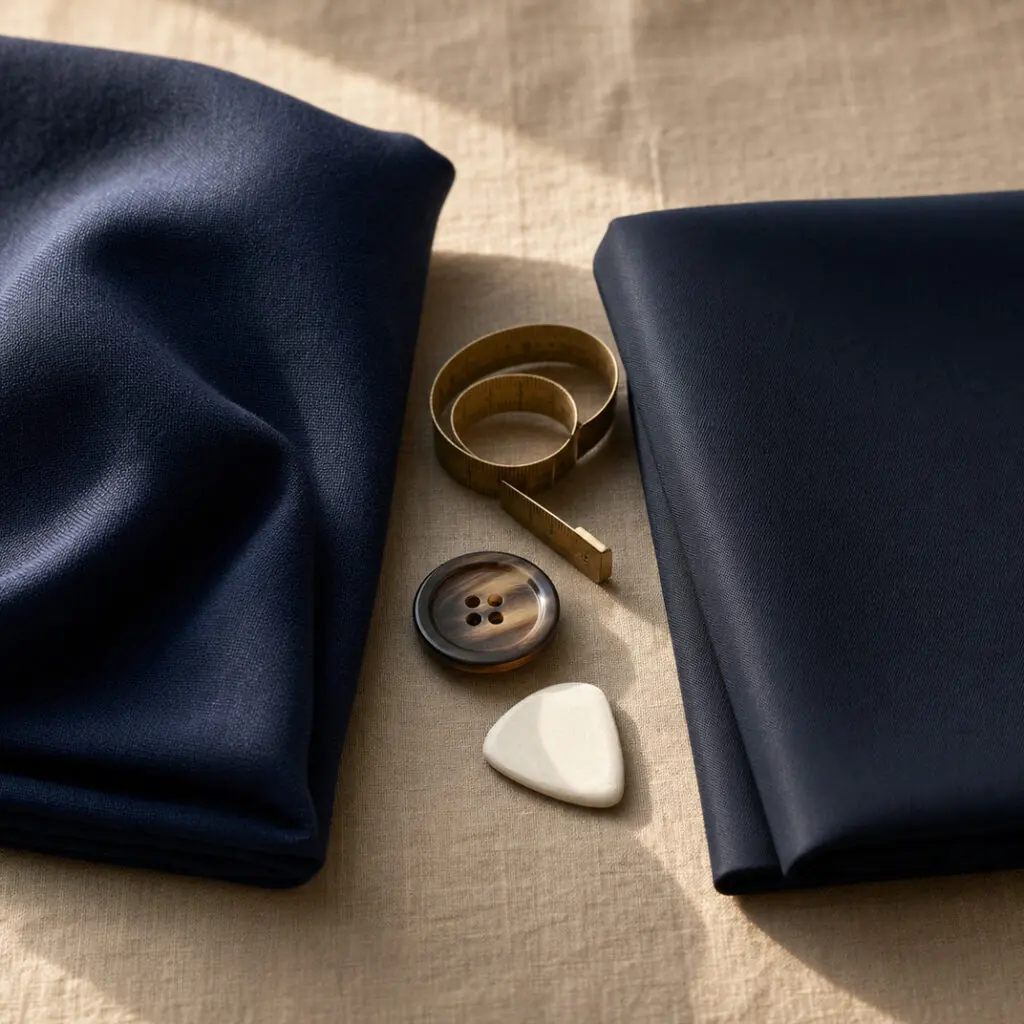
Midnight navy, specifically, reads as more serious and formal than a medium or bright blue. For professional settings or formal occasions, midnight navy is indistinguishable in gravitas from charcoal. For less formal occasions, navy has a warmth and accessibility that charcoal lacks.
Navy at Weddings
As a groom, navy is the dominant suit choice for modern weddings precisely because it works in every season and at every level of formality below black-tie. A midnight navy wool flannel suit for a fall wedding or a mid-weight navy worsted for a spring ceremony is correct in both casual and formal settings. Navy also coordinates naturally with nearly every bridesmaid color palette, which simplifies the visual cohesion of the wedding party.
As a wedding guest, navy is the safest and most universally appropriate choice. It reads as appropriately dressed without risking outshining or conflicting with the wedding party. It works for daytime or evening weddings, indoor or outdoor settings, and every dress code from cocktail attire down to smart casual.
Navy in Professional Settings
In law, finance, consulting, healthcare management, and virtually every other professional field, a midnight navy suit reads as polished and authoritative without the heaviness of charcoal. It is one of the two foundational business suit colors for good reason. It pairs cleanly with white shirts, light blue shirts, and pale grey shirts. It works with virtually every tie color and pattern.
Navy as a Separate
A navy suit jacket is the most effective separate in a man’s wardrobe. Worn without the matching trousers and paired with grey flannel trousers, charcoal chinos, or well-fitted dark denim, it functions as a navy sport coat that covers smart casual and business casual occasions with equal effectiveness. No other suit color crosses this boundary as cleanly.
Navy and Shoe Versatility
Navy is the only suit color that works equally well with black shoes, dark brown shoes, and tan or cognac leather. This is a practical advantage that is easy to underestimate. Charcoal works best with black shoes. Black suits require black shoes. Navy’s shoe flexibility means it pairs with footwear you likely already own.
Charcoal: The Authoritative Choice
Charcoal grey is the most formally authoritative color in men’s suiting. If navy is the versatile everyday choice, charcoal is the suit you wear when the occasion specifically calls for gravitas.
Why Charcoal Commands Respect
Charcoal reads as serious, deliberate, and controlled. In fields where projecting formal authority matters most, such as law, finance, or executive management, a charcoal suit signals that you understand the weight of the context and dressed accordingly. It is appropriate for funerals, courtrooms, job interviews, client presentations, and formal evening events in a way that no other suit color covers as completely.
Charcoal is one of the two suit colors that every experienced menswear professional agrees belongs in every man’s wardrobe alongside navy.
Charcoal at Weddings
As a groom, charcoal is an excellent choice for formal, semi-formal, and winter weddings. It reads as intentional and traditional. The combination of charcoal and a white shirt is one of the most formally correct combinations in menswear, which makes it the right choice for grooms who want to look traditional and polished rather than fashion-forward.
As a wedding guest, charcoal is always appropriate and never calls attention to itself. It will not conflict with the wedding party’s attire, it works at every venue and every dress code above casual, and it photographs well under any lighting condition.
Charcoal’s Trade-Off
The trade-off for charcoal’s authority is flexibility. Charcoal reads as serious in nearly every context, which is an asset in a courtroom and a slight limitation at a casual summer wedding or a creative industry networking event. It pairs most naturally with black shoes and struggles slightly more than navy when worn as a casual separate.
For professionals whose primary use of a suit is formal business contexts, this limitation is irrelevant. For men who want a suit that works across the widest range of tones and occasions, navy pulls slightly ahead.
Black: The Most Restricted Choice
Black suits are the most commonly misunderstood color in menswear. Many men assume black is the most formal and therefore the most correct choice. The opposite is true in practice.
Why Black Is Not the Right First Choice
Want to see how this plays out in a real build? Explore our business suits page - it walks through fabrics, construction, and what to expect at your first appointment.
Black is reserved in most menswear guidance for black-tie contexts, where a tuxedo is specifically called for and a dark suit is the closest acceptable alternative. Outside of this specific context, black suits are heavily restricted in their versatility.
Black suits pair with black shoes only. They do not work with brown leather in any shade. They are too dark for most daytime occasions. They can look costume-like rather than polished in contexts that do not call for extreme formality. They require careful styling to avoid looking like hotel staff or a security professional rather than a polished guest or professional.
When Black Works
Black suits are entirely appropriate in the following contexts:
- Black-tie optional events: When a tuxedo is welcome but not required, a well-fitted black suit with satin-finish accessories reads as correct and polished.
- Formal evening weddings: An evening wedding beginning after 4 p.m. at an upscale venue is a context where black reads as appropriate rather than excessive.
- Funerals and memorial services: Black is the traditional and most respectful choice for funeral attire.
- Cocktail attire events in urban settings: Evening cocktail events in a city context, particularly at venues like the Kauffman Center in Kansas City, suit black well.
When Black Does Not Work
- Daytime weddings, especially outdoor or garden settings
- Casual or semi-casual professional environments
- Business meetings below the executive level
- Any context where navy or charcoal would look more natural and polished
Head-to-Head: The Three Colors Compared
- Overall versatility: Navy: Excellent; Charcoal: Very Good; Black: Limited
- Business wear: Navy: Excellent; Charcoal: Excellent; Black: Poor to Moderate
- Wedding (groom): Navy: Excellent; Charcoal: Excellent; Black: Good (evening only)
- Wedding (guest): Navy: Excellent; Charcoal: Excellent; Black: Good (formal and evening only)
- Funeral or memorial: Navy: Good; Charcoal: Excellent; Black: Excellent
- Cocktail evening events: Navy: Excellent; Charcoal: Excellent; Black: Excellent
- Works with brown shoes: Navy: Yes; Charcoal: Rarely; Black: No
- Works with black shoes: Navy: Yes; Charcoal: Yes; Black: Yes
- Works as a separate jacket: Navy: Excellent; Charcoal: Moderate; Black: Poor
- Daytime occasions: Navy: Excellent; Charcoal: Good; Black: Poor
- Recommended as first suit: Navy: Yes; Charcoal: Yes; Black: No
Complexion and Color: What Most Guides Skip
Suit color interacts with your skin tone and natural coloring in ways that affect how polished and intentional you look.
Navy works across the widest range of complexions. Men with medium to darker skin tones often find that navy creates better facial contrast and warmth than the cooler tones of charcoal. It reads as rich and deliberate without the stark contrast that very dark charcoal or black can produce.
Charcoal creates excellent contrast on lighter complexions and works very well on medium complexions. On darker complexions, the cooler grey tones can sometimes recede rather than frame the face. This is not a hard rule, but it is worth considering when choosing between navy and charcoal as your first suit.
Black creates the maximum possible contrast with light skin and can appear harsh rather than elegant. On medium and darker complexions, black reads differently and often more naturally. This is one reason black suits appear more commonly appropriate in some cultural and regional contexts than in general menswear guidance.
The Right Order for Building a Wardrobe
If you are building from scratch or adding to what you already own, the guidance is consistent across virtually every menswear professional:
First suit: Midnight navy in mid-weight worsted wool. This covers the widest range of occasions, seasons, and professional contexts.
Second suit: Charcoal grey in mid-weight worsted or wool flannel. This adds formal authority and covers the occasions where navy feels slightly too approachable.
Third suit: A medium grey, a pattern in navy or grey, or a seasonal option such as a tropical wool for summer or a heavyweight flannel for winter. At this point, you can also consider adding black if your social calendar regularly includes black-tie optional events.
When you're ready to put this into practice, you can book a mobile fitting at your home or office with Brandon and get measured in person.
For a complete guide to building a Kansas City professional wardrobe around these three suits, see our Kansas City executive wardrobe guide.
Frequently Asked Questions
Q: Can I wear a navy suit to a formal black-tie wedding?
If the invitation says black tie, a tuxedo is the correct choice. If you do not own a tuxedo and cannot rent one, a midnight navy or black suit with formal accessories is the most acceptable alternative. A standard navy suit is not the same as black-tie dress. For black-tie optional events, navy works well.
Q: Is a black suit appropriate for a job interview?
In most professional contexts, navy or charcoal is a stronger choice for an interview than black. Black reads as overly formal for daytime business contexts and can appear funereal rather than polished. The exceptions are industries where black specifically signals appropriate cultural alignment, such as certain fashion, entertainment, or evening hospitality roles.
Q: Can I wear charcoal to a summer wedding?
Yes, if the dress code calls for it. A lightweight charcoal worsted in tropical wool weight works for formal summer occasions. For a casual or outdoor daytime summer wedding, a lighter grey or navy in a lighter weight is often a more natural and comfortable choice.
Q: Is navy or charcoal better for photographing well?
Both photograph extremely well. Navy tends to look richer and warmer in photos, which works well in natural light. Charcoal photographs with more contrast and formality. Black can produce blown-out dark patches under certain lighting conditions and generally requires more careful photography to render well.
Q: Which color is best for the groom at a Kauffman Center wedding?
The Kauffman Center is one of Kansas City’s most architecturally prestigious venues. For a ceremony and reception in Brandmeyer Great Hall or the Muriel Kauffman Theatre, the formality of the space calls for midnight navy, charcoal, or, for evening ceremonies specifically, black or a tuxedo. The venue’s glass curtain wall and city skyline backdrop photograph best with dark, rich suit colors that create clean contrast.
Q: I already own a navy suit. Should my second suit be charcoal?
For most professionals, yes. Charcoal fills the formality gap that navy occasionally leaves. If your first navy suit sees daily professional use, a charcoal in the same or slightly heavier weight for fall and winter use is the natural second choice. If you already own both, your third suit can explore seasonal options or consider whether black is warranted for your specific event calendar.
Q: I have a darker complexion. Does that change the recommendation?
Navy remains the best starting point. It creates strong, warm contrast that flatters medium to darker complexions more consistently than charcoal’s cooler tones. Charcoal can still work very well depending on your specific skin tone and the shade of charcoal, but if you are choosing your first suit and have a medium to darker complexion, navy is the safer first choice.
Key Takeaways
- Navy is the most versatile suit color: It covers the widest range of occasions, works with the most shoe and shirt combinations, and functions as a casual separate. It is the correct first suit for most men.
- Charcoal is the most formally authoritative: It is the right first choice for professionals in law, finance, and fields where formal gravitas is the primary signal. It is the right second suit for everyone else.
- Black is the most restricted: It belongs in black-tie optional and evening formal contexts. It is not the right first or second suit for most men.
- Build navy first, charcoal second: This two-suit foundation covers approximately 90% of all suit-wearing occasions correctly.
- Color interacts with complexion: Navy is most universally flattering. Charcoal works best with lighter and medium complexions. Black requires careful consideration of occasion and context.
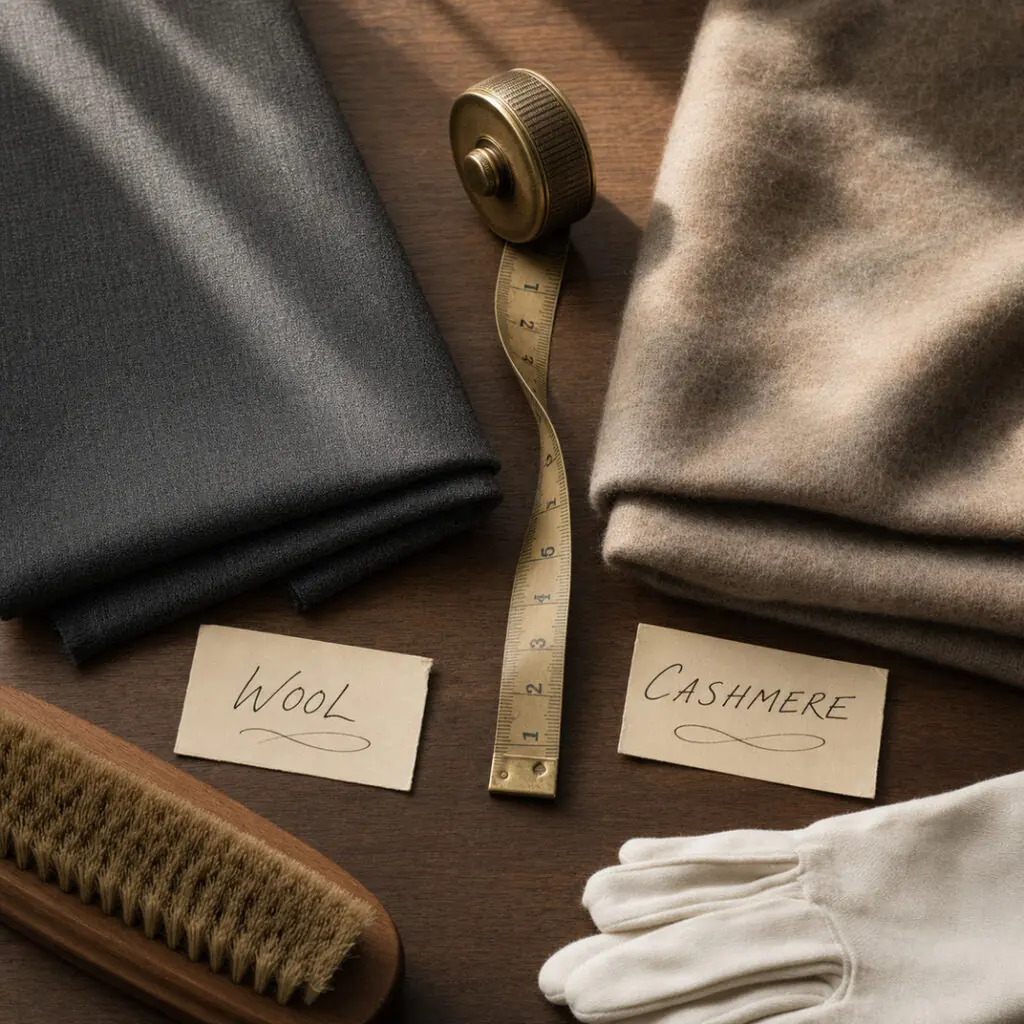
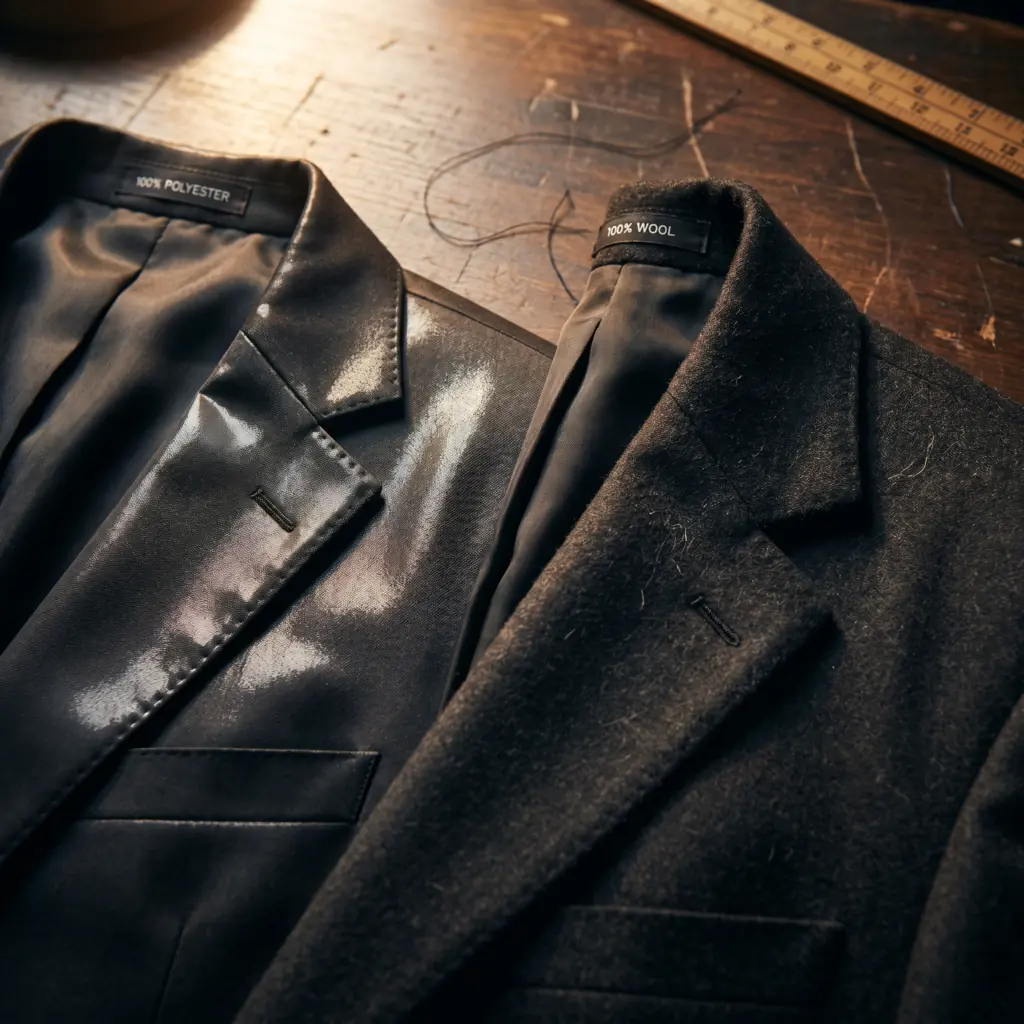
- All three colors should be in wool: The color is only as powerful as the fabric it comes in. Mid-weight worsted wool in any of these three colors outperforms any synthetic fabric.
Ready to Build Your Wardrobe the Right Way?
You now have the framework to make an informed, confident decision about suit color. The next step is choosing the right fabric weight, finding the shade within each color that works for your complexion and lifestyle, and getting a fit that makes the color work in your favor.
The Suit Doctor offers:
- Made-to-measure suits in midnight navy, charcoal grey, and black in premium wool fabrics
- Expert color consultation matched to your complexion, industry, and event calendar
- Mobile fitting appointments at your home or office across Kansas City
- Three-piece options and seasonal fabrics including flannel and tropical wool in all three colors
- Groomsmen coordination for navy and charcoal wedding party suits
Ready to get started? Schedule your Kansas City suit consultation and we will bring fabric samples and color guidance to you.
Also see our Kansas City winter wedding suit guide for seasonal color and fabric guidance specific to fall and winter ceremonies.
The Suit Doctor | Custom and Made-to-Measure Suits for Men Who Take Their Look Seriously.
Get measured for a suit built around how you actually live.
Suits built for boardrooms, travel, and long days on your feet.