Walk into any department store and you will find polyester suits hanging next to wool suits at nearly identical price points. The labels look similar. The silhouettes look similar. Under the fluorescent store lighting, they may even look similar. But the moment you step outside, stand under flash photography at a wedding, or sit through a four-hour business conference, the difference becomes impossible to ignore.
This guide explains exactly why polyester suits look cheap, what is happening at the fiber level that causes that look, when a polyester suit can actually make sense, and why wool remains the correct choice for any occasion that matters.
TLDR: Polyester suits look cheap because of how synthetic fibers reflect light, trap heat, and lose their shape. Wool suits cost more upfront but outperform polyester in every category that matters. Polyester has exactly two legitimate use cases. Read on to understand why.
Why Polyester Suits Look Cheap: The Science Behind the Shine
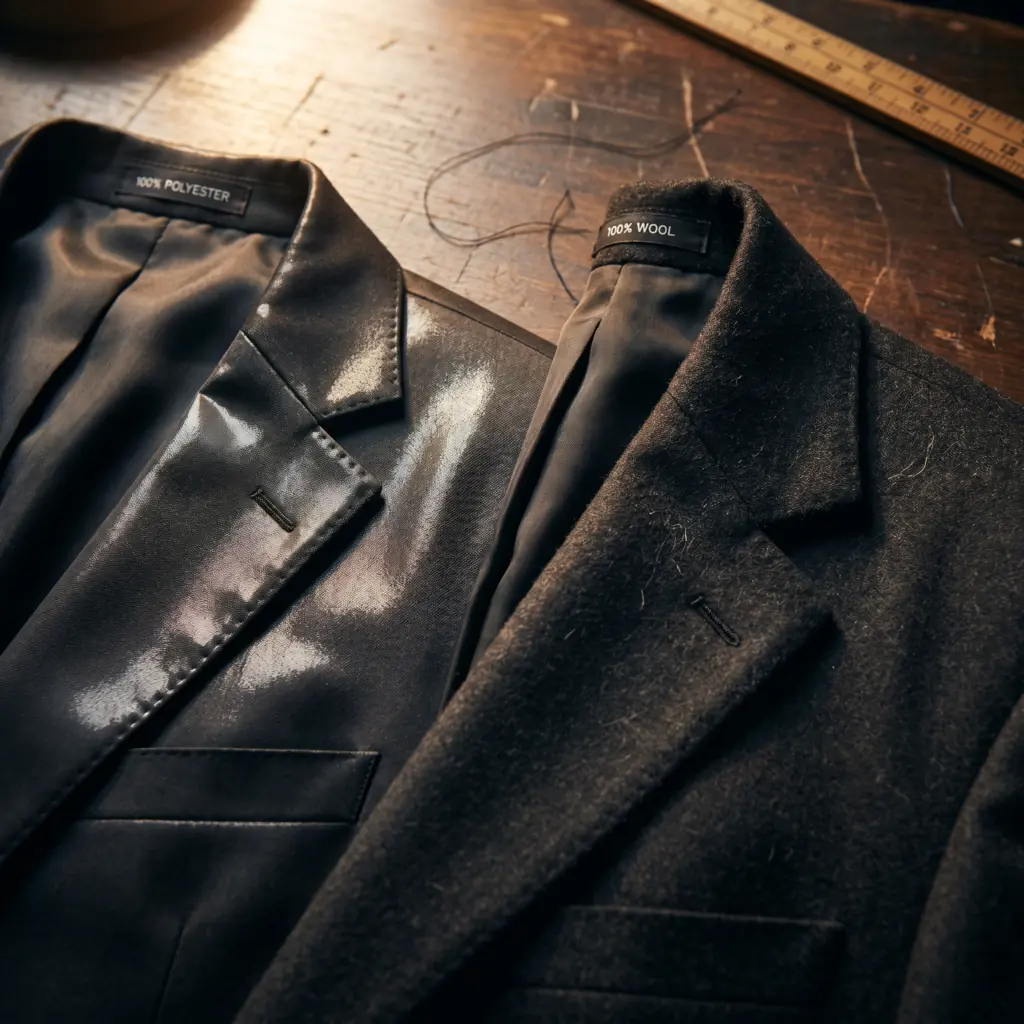
The most visible problem with a polyester suit is the shine. It is not a subtle difference. Under natural daylight, indoor venue lighting, or camera flash, a polyester suit produces a flat, glossy surface that immediately reads as synthetic to any trained eye.
This happens because of the physical structure of polyester fibers at the microscopic level. Standard polyester is made from continuous filament fibers: long, perfectly smooth, round strands that run uninterrupted through the fabric. Because these strands are smooth and uniform, they act like microscopic mirrors. When light hits the surface, it reflects directly back in a single concentrated direction rather than scattering in multiple directions. This is called specular reflection, and it produces the flat, shiny appearance that is the defining visual characteristic of a cheap polyester suit.
Wool fibers work in the opposite way. Natural wool has an irregular, scaled surface structure with tiny variations across every fiber. When light hits wool, it scatters in multiple directions simultaneously, producing what is called diffuse reflection. The result is a deep, rich, three-dimensional appearance that makes the fabric look substantial and textured rather than flat and plastic.
Under flash photography, which is unavoidable at weddings, formal events, and professional headshots, this difference becomes even more pronounced. Polyester’s specular reflection creates blown-out bright patches and hot spots in photos. Wool’s diffuse reflection maintains depth and texture in every frame.
The Heat Problem: Polyester Traps Everything
Beyond appearance, polyester has a fundamental functional problem: it does not breathe.
Wool fibers have a natural crimp structure with tiny air pockets built into the fiber itself. These pockets allow air circulation and draw moisture away from the body through a process called wicking. This is why wool can feel cool in warm conditions and warm in cool conditions. It actively manages your body’s microclimate.
Polyester does none of this. It is essentially a plastic fiber. It does not wick moisture, it does not allow meaningful airflow, and it does not regulate temperature. In a polyester suit, perspiration has nowhere to go. It accumulates against the body, creating discomfort and visible dampness that compound the cheap appearance.
In Kansas City’s climate, where summer temperatures regularly exceed 90 degrees with significant humidity and even indoor events can become warm with a large crowd, polyester is genuinely uncomfortable to wear. A man in a polyester suit at an August wedding reception is not having a good time, and that discomfort is visible.
The Shape Problem: Polyester Gives Up
The third major failure of polyester suits is structural. Polyester does not hold its shape across a long day of wear.
Wool fibers have a natural elasticity built into their crimp structure. When you sit down, stand up, reach across a table, or dance at a reception, the jacket stretches and returns to its original shape. This is what tailors mean when they describe a fabric as having good recovery. A quality wool suit looks as sharp at 10 p.m. as it did at 2 p.m. because the fibers bounce back.
Polyester stretches but does not fully recover. It retains the deformation from repeated movement, developing a baggy, shapeless appearance around the elbows, at the knees, and across the seat over the course of a long day. The longer you wear a polyester suit, the worse it looks.
The Longevity Problem: Polyester Does Not Age Well
Cost-per-wear is the most honest way to evaluate the true value of any suit.
A polyester suit typically retails between $50 and $150. It looks acceptable on the rack. After 10 wearings, the shine has increased, the shape has degraded, and the fabric has developed a worn, flat appearance that no amount of cleaning or pressing can reverse. At $80 for 10 wearings, that is $8 per wear.
A mid-range wool suit at $400 to $600 worn 50 or more times across several years costs $8 to $12 per wear, but looks better and better with proper care. A well-constructed wool suit with canvas construction can last 10 to 15 years with rotation and appropriate maintenance. The economics of wool are significantly better than they first appear.
What About Modern Polyester Blends?
The most common response to criticism of polyester suits is that modern polyester blends are much better. This deserves a direct answer.
Some improvements have been made. Wool-polyester blends that are 70% or more wool can perform reasonably, since the wool content carries most of the functional properties. Spun polyester, where long filament fibers are chopped into short staple lengths and then twisted together, produces a matte finish rather than a shiny one because the irregular twisted surface scatters light more like wool.
But the improvements have limits. Even the best polyester blends breathe less than pure wool. They recover from deformation less completely. They still show specular glare under camera flash. The practical guidance from most experienced tailors is to avoid any suit where polyester content exceeds 20 to 30% of the fabric weight.
When Polyester Actually Makes Sense
There are exactly two situations where a polyester suit is the rational choice.
Situation 1: One-Time Use with No Reuse Value
If you genuinely need a suit for a single occasion, have no budget for wool, and have no intention of wearing the suit again, a polyester suit does the job. This applies to:
Want to see how this plays out in a real build? Explore our business suits page - it walks through fabrics, construction, and what to expect at your first appointment.
- A high school student buying a suit for one prom appearance with no subsequent professional wardrobe needs
- A costume or theatrical application where the garment will be used under stage lighting rather than natural light or flash photography
- A non-recurring event where fit and presentation matter less than having any suit at all
In these cases, the lower price point is the primary decision factor, and the functional limitations of polyester are acceptable because the suit is not expected to perform or last.
Situation 2: Extremely High-Abuse Environments
Some professionals need a suit that can withstand conditions that would destroy a fine wool garment: outdoor fieldwork, trade shows requiring physical setup and breakdown, or environments with chemical or staining risk. In these specific contexts, a polyester suit may offer durability that outweighs its appearance limitations.
This is a narrow exception that applies to very few professional contexts.
Polyester vs. Wool: Direct Comparison
The differences are clearest side by side. For an even deeper breakdown, see our Kansas City wool versus polyester suit comparison.
- Light reflection: Polyester Suit: Specular (shiny, flat); Wool Suit: Diffuse (deep, textured)
- Breathability: Polyester Suit: Poor; Wool Suit: Excellent
- Temperature regulation: Polyester Suit: None; Wool Suit: Active wicking and insulation
- Shape retention: Polyester Suit: Poor over time; Wool Suit: Excellent with care
- Photography performance: Polyester Suit: Shiny patches and hot spots; Wool Suit: Rich, dimensional appearance
- Lifespan with regular wear: Polyester Suit: 1 to 3 years; Wool Suit: 10 to 15 years with care
- Cost per wear: Polyester Suit: Higher than it appears; Wool Suit: Lower than it appears
- Appropriate occasions: Polyester Suit: Costume, one-time use; Wool Suit: All professional and formal occasions
What to Do Instead of Buying a Polyester Suit
If budget is the primary concern, the correct answer is not a polyester suit. It is an entry-level wool suit at a lower Super number.
A Super 100s worsted wool suit at 270 to 290 GSM from a reputable source can be found for $300 to $500, and it will outperform a $150 polyester suit in every meaningful way from the first wearing onward. The price difference is real, but the performance and longevity difference more than closes the gap over time.
Made-to-measure wool suits are also more accessible than most men assume. A precisely fitted mid-weight worsted wool suit from The Suit Doctor offers dramatically better value than an ill-fitting polyester suit from a department store rack, because fit is the multiplier that makes every other property of the fabric work correctly.
For guidance on choosing the right wool fabric for your specific needs, see our Kansas City business suit fabric guide or schedule a Kansas City consultation to handle real fabric samples before making any decision.
Frequently Asked Questions
Q: Can you tell a polyester suit from a wool suit just by looking?
Usually, yes. The most reliable visual test is shine. Wool has a matte, deep appearance even in bright light. Polyester produces a flat, slightly glossy surface that becomes more obvious under natural light or flash photography. You can also do a hand-feel test: wool feels slightly textured and warm, while polyester often feels smooth, slightly cool, and plastic-like. When in doubt, check the fabric label.
Q: Is a wool-polyester blend acceptable?
It depends on the ratio. A suit that is 70% or more wool performs similarly to a pure wool suit with modest wrinkle resistance added. A suit that is 50% or more polyester will show the limitations of polyester in appearance and comfort. If polyester is the primary listed fiber on the label, the suit will perform like a polyester suit.
Q: Are polyester suits ever appropriate for weddings?
When you're ready to put this into practice, you can book a mobile fitting at your home or office with Brandon and get measured in person.
For the groom or wedding party, no. For a guest on an extremely limited budget attending a casual daytime wedding, a polyester suit in good condition is acceptable. For any formal evening wedding, a black-tie optional event, or an event at a premium venue like the Kauffman Center in Kansas City, wool is the correct choice. Polyester under flash photography at a formal wedding creates unflattering results in every photo.
Q: Do polyester suits work for job interviews?
A well-fitted polyester suit is better than showing up in casual clothing, but it does communicate something to an experienced observer. In professional environments where appearance signals competence and attention to detail, the fabric choice is part of the message. If the interview is for a senior role, a client-facing position, or any field where professional presentation matters, the investment in a wool suit is worth making.
Q: What about stretch suits with synthetic content?
Stretch suits typically use a small percentage of elastane blended with wool, usually 2 to 5%. This amount of synthetic content adds mobility without significantly compromising the appearance or breathability of the wool. This is categorically different from a primarily polyester suit. Wool-elastane blends perform well and are widely used in made-to-measure tailoring for active professionals.
Q: How can I make a polyester suit look better if I already own one?
Fit is the most powerful tool available. A polyester suit that fits precisely will look dramatically better than one that does not. Steam rather than iron to reduce shine, since direct heat from an iron can increase polyester shine by slightly melting the surface fibers. Pair it with quality accessories and shoes, which shifts the eye away from the fabric. Limit wear to low-stakes occasions and keep it out of contexts with flash photography.
Q: How do I know what fiber content a suit is made from?
Every garment sold in the United States is legally required to have a fiber content label. Check the interior label near the collar or along the inside seam of the jacket. It will list the fabric composition as a percentage. If no label is present, that is itself a sign of lower manufacturing standards.
Key Takeaways
- Polyester looks cheap because of physics: The smooth, uniform surface of polyester fibers reflects light directly back at the eye rather than scattering it, producing the flat, shiny appearance that makes the fabric read as synthetic.
- Polyester fails at comfort: It does not breathe, does not wick moisture, and traps body heat. In Kansas City’s climate, this creates real discomfort in almost every season.
- Polyester loses its shape: Unlike wool, polyester does not recover from repeated movement. A polyester suit looks worse as the day goes on.
- Cost-per-wear math favors wool: A $400 wool suit worn 50 times costs less per wearing than an $80 polyester suit worn 10 times, and looks exponentially better throughout.
- Polyester has two legitimate uses: One-time no-reuse situations and extreme-abuse environments. These are narrow exceptions, not the norm.
- Modern blends help at high wool ratios: A suit with 70% or more wool content performs much closer to a pure wool suit. Below 50% wool, polyester dominates the performance characteristics.
- The alternative is an entry-level wool suit: Entry-level worsted wool is accessible at price points most people assume require synthetic fabrics.
Ready to Feel the Difference?
If you have worn polyester suits and wondered why they never quite looked right, the answer is in the fiber. Wool is not a luxury upgrade. It is the baseline correct material for a suit that works in real life.
The Suit Doctor offers:
- Made-to-measure business suits in premium worsted wool starting at accessible price points
- Fabric samples brought to your location so you can feel the difference before committing
- Expert guidance on fabric selection, construction, and fit for every budget level
- Mobile fitting appointments at your home or office across Kansas City
Ready to stop compromising on fabric?
Schedule your Kansas City suit consultation and we will show you exactly what the right material feels like.
The Suit Doctor | Custom and Made-to-Measure Suits for Men Who Take Their Look Seriously.
Get measured for a suit built around how you actually live.
Suits built for boardrooms, travel, and long days on your feet.