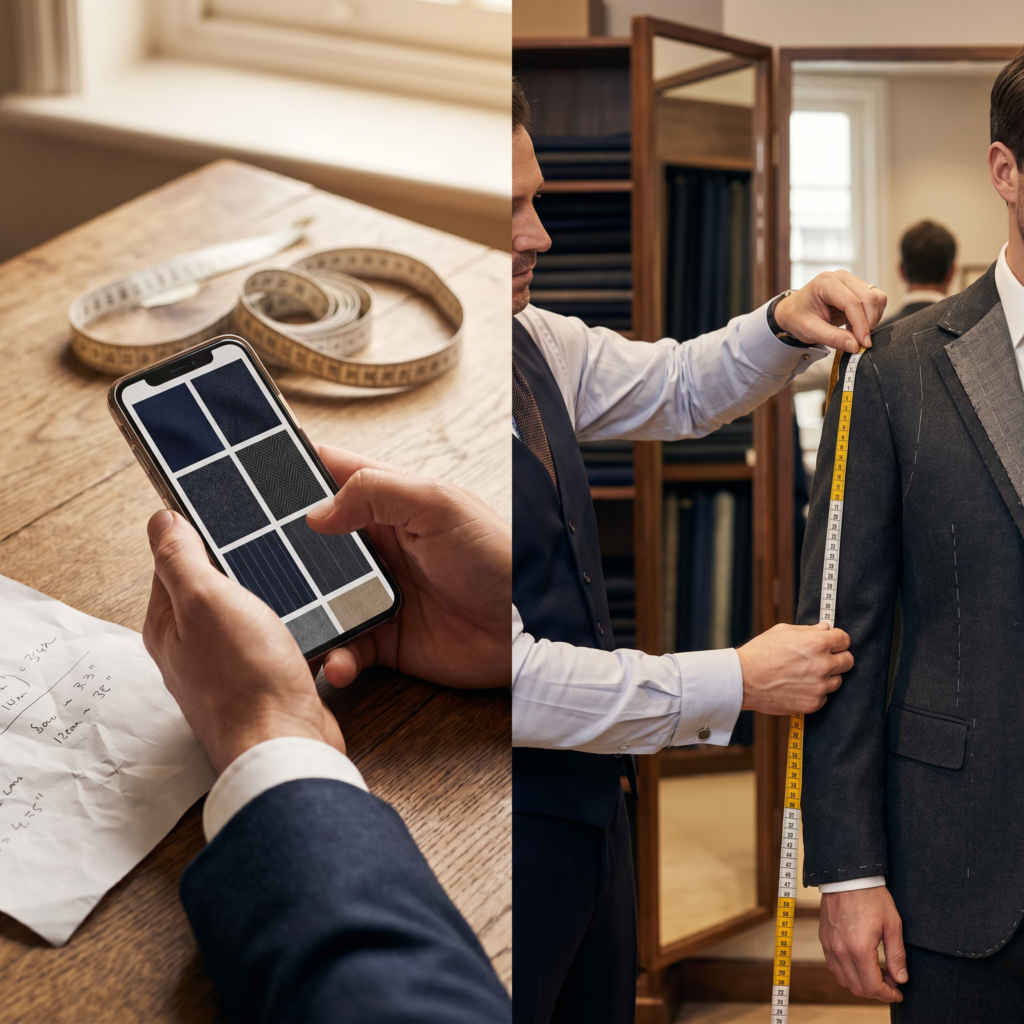
Online made-to-measure suits look like the easy answer. You tap through fabric swatches on your phone, enter your measurements, and a jacket lands on your doorstep a few weeks later. This guide gives Kansas City buyers a straight, side-by-side look at online and local options, including the costs the websites do not show you, so you can choose with your eyes open.
TLDR: Online made-to-measure feels like a shortcut, but self-measurement errors, short return windows, and capped alteration credits can quietly turn a budget suit into a pricey headache. A local Kansas City tailor costs more upfront and gives you accurate measurements, posture adjustments, and a jacket that fits before you walk out. Read on for the real cost breakdown, the fit risks most buyers miss, and when each option actually makes sense.
You have seen the ads. A sharp model, a low price, and a promise that a few taps will get you a suit built just for you. For some buyers in some situations, that promise holds up. For plenty of others, the process exposes a hard truth: a suit cut from your own measurements is only as good as those measurements, and most first-timers who measure at home get several wrong.
A local tailor brings something no app can replicate: a trained eye in the room with you. They watch how you stand, how your shoulders sit, whether one side rides higher than the other, and whether your posture pulls the jacket forward or back. None of that fits in an online form, and it is often the line between a suit that drapes cleanly and one that fights you every time you put it on.
Both paths deserve a fair hearing. Here is what you need to know before you spend anything.
Why Your Measurements Are Harder to Get Right Than You Think
When an online brand says, “Just measure yourself at home,” it sounds simple. You need a tape measure and about fifteen minutes. Getting those numbers accurate enough for custom tailoring, though, is a different story.
Most brands ask for ten to fifteen separate measurements: chest, waist, seat, shoulder width, sleeve length, jacket length, neck, inseam, thigh, and more. Each has a correct technique. Pull the tape a little tight across the chest, and the jacket comes back snug. Read your shoulder a quarter inch wide, and the seam slides down your arm. Miss the jacket length, and the hem hangs at an odd line.
The Posture Problem: No Form Captures
Here is the deeper issue that accuracy alone cannot fix: posture. Two men can share the same chest measurement and have completely different bodies. One carries forward-rolled shoulders and a slightly rounded upper back. The other stands square and upright. A pattern cut to identical numbers will flatter one and fight the other for the life of the garment.
A tailor working in person catches this right away. They see how your spine curves, whether your hips tilt, and whether your shoulders slope unevenly. That read shapes the pattern before anything is cut. An online form sees a list of numbers and nothing else.
Pro tip: If you have athletic shoulders, a fuller chest relative to your waist, one shoulder higher than the other, or any forward lean, your odds of a poor first-order fit from an online brand go up sharply.
The Real Cost of an Online Made-to-Measure Suit
The advertised price is rarely the price you pay. Here is what a Kansas City buyer often pays once the first order does not land perfectly.
What the Sticker Usually Covers
Online made-to-measure spans a wide range. Entry-level suits tend to start in the few-hundred-dollar range, with mid-tier fabrics climbing past a thousand depending on cloth and brand. Several major online brands have also raised prices in recent cycles, so the number you saw last year may not be the number today. The base price usually includes fabric choice, simple customizations like lapel style and lining color, and standard delivery.
What it usually does not include: return or remake shipping, alterations beyond a small credit, and the value of your own time managing the process.
The Hidden Cost of Alterations
Almost every online brand offers some alteration help when a suit does not fit. In practice, the credit is modest, and the clock is short. A common structure is a reimbursement of roughly $75, paid only if you submit a tailor’s receipt within about 2 weeks of delivery. I miss that window, and the claim is gone.
Now, the math that surprises people. A Kansas City tailor doing real alterations on a jacket, taking in the chest, shortening sleeves, adjusting the seat of the trousers, generally charges more than that small credit covers. So you absorb the difference, and if your event is close, you are now running a second alteration project on a tight clock.
The Remake Scenario
When alterations cannot save the fit, brands offer a remake. That sounds like a safety net, and sometimes it is. Often, it means more weeks of waiting, and some buyers report the second attempt still misses because the original measurement data was off to begin with. Most custom orders are also non-refundable by policy, since the garment was cut to your spec, so resolution always means more time rather than your money back.
Pro tip: Map your full timeline before you order online. If you need the suit in six weeks and the order requires a remake, the suit will arrive after your event.
What a Local Kansas City Tailor Actually Provides
A local tailor charges more up front. That is simply true. Understanding what the premium buys is what makes the full math click, because it frequently favors local once you count everything.
Measurements Taken Once, Correctly
A professional measures you with techniques refined over years on real bodies. They measure while you stand naturally, not while you twist over a bathroom counter trying to reach your own shoulder blade. Posture gets accounted for automatically because they can see it.
If your right shoulder sits lower than your left, if your upper back has a pronounced curve, if you carry weight unevenly, that information shapes the pattern before construction starts. The form never asked, but the tailor already saw it.
A Fitting Before You Pay In Full
With a local made-to-measure or custom program, you typically try on the garment before it is finished. Adjustments happen at that stage, while changes are still easy to make. That fitting is not a perk bolted onto the local experience. It is the core of it.
You leave knowing the suit fits and not hoping. Knowing.
A Relationship That Pays Off Over Time
A local tailor keeps a record of your measurements, preferences, and body quirks. Every suit after the first comes out better, because they are refining a pattern built specifically for you. Online brands store your numbers in a database, but stored data and a human who has actually fitted you are not the same thing.
You also gain a local resource for future alterations and repairs. If your weight shifts, someone who already knows your suit can work with it intelligently. For a fuller look at what goes into that investment, our breakdown of why custom suits in Kansas City cost what they do walks through every line item.
Pro tip: Treat your first local custom suit as the most expensive one you will ever buy per wear, and every one after it as the best value. The first order lays the foundation for the rest.
The Honest Comparison Table
Here is where online and local sit side by side. The goal is not to crown a winner but to show the trade-offs plainly. Depending on which factors matter most to your situation, either column can come out ahead, so use this to weigh your own priorities before spending a dollar.
| Factor | Online Made-to-Measure | Local Kansas City Tailor |
|---|---|---|
| Starting price | Lower upfront, wide range by brand and fabric | Higher upfront; reflects skilled labor and in-person service |
| Measurement accuracy | Depends on your own technique; real room for error | Professional measurement, posture observed directly |
| Posture adjustments | Not captured by standard forms | Assessed and built into the pattern before cutting |
| Fit guarantee | Small alteration credit or remake, with strict deadlines | Fitting appointment; changes made before final delivery |
| Refund policy | Generally none on custom orders | Varies; you talk it through before problems escalate |
| Turnaround | A few weeks standard, add time for remakes | Varies by program, often a few weeks for made-to-measure |
| Ongoing value | Numbers stored digitally, no personal read of your body | Pattern improves with every order |
| Best for | Standard proportions, relaxed timeline | Generally, none on custom orders |
For most buyers, the deciding factors are the alteration cap and the short claim window, since those are the two things people rarely read until the suit is already in hand. Know them before you order, not after.
How to Tell If Online Is Right for You
Online made-to-measure is not wrong for everyone. It is wrong in certain cases and for certain buyers. Here is how to tell which group you are in.
Online Can Work Well If:
- You have a fairly standard build without major posture variations
- You were professionally measured recently and trust your numbers
- You have time to absorb a possible remake with no hard deadline
- You want a lower-cost entry point for an occasional suit
- You can get to a showroom or local tailor quickly if something is off
Local Is the Smarter Call If:
- You have athletic shoulders, a high chest, a sloping shoulder, or any posture that the tape cannot capture
- You are buying for a high-stakes event, such as a wedding, key interviews, or anything photographed heavily
- You want a suit relationship that improves with each order
- You will wear the suit often and want construction that matches that use
- You want a person in front of you who knows the work and can be held accountable face to face
Real Scenarios: Which Option Fits Your Life
The Groom With Six Months to Plan
With that much runway, a groom could use either path. But the wedding suit gets photographed from every angle for hours, and a jacket that fights his posture will show in every frame. The local route gives him a fitting where he sees the suit on his body before the day, plus a tailor he can call if something needs a touch-up the week of the ceremony. That peace of mind does not show up in a price comparison, but it is real. If you are mapping out the whole look, our Kansas City custom wedding suits page covers how fabric, fit, and coordination come together for the wedding party.
The Business Professional Building a Wardrobe
Someone wearing suits three or more days a week should not have to juggle reimbursement windows and potential remakes every time they add to the rotation. A local tailor with their pattern on file turns around each new order efficiently, and every suit benefits from the accuracy of the last. Over a wardrobe’s worth of suits, the relationship wins on both time and money.
The Prom Attendee on a Budget
For one night, an online suit in a standard size range can absolutely look sharp. The keys are ordering with real lead time, at least eight weeks to absorb a hiccup, following the measurement video carefully with a second person helping, and choosing a brand with a fair alteration policy. If the fit lands close, a quick local stop for sleeve length and trouser break can finish it off.
The First-Time Buyer Who Is Not Sure
If you have never been measured by a professional, your first suit should be done in person. You will learn more about how your body should be dressed in one appointment than in three online orders. That knowledge follows you into every purchase after that, whether online or local.
Five Questions to Ask Before You Choose
Before you order anywhere, get clear answers to these.
- Is this a full canvas, a half canvas, or a fused construction? Construction decides how long the suit lasts and how it molds to you. An online budget suit in fused construction is not the same investment as a local suit in half-canvas at a similar price.
- What is the alteration policy, and what is the exact deadline? If the answer is a two-week window and a small dollar cap, do the math on whether that actually protects you.
- What happens if the remake still does not fit? Some brands answer this cleanly. Others get vague. The answer tells you what kind of process you are signing up for.
- Do you account for posture or body asymmetry? If there is no mechanism to capture it, you are ordering from a standardized system regardless of the word “custom.”
- What is the realistic total timeline, including alterations? Work backward from your event. If the numbers do not leave a buffer, go local.
Frequently Asked Questions
Are online made-to-measure suits actually custom? They are custom in that they are cut to your submitted measurements rather than pulled from a size rack. They are not custom in the traditional sense of a pattern drafted from scratch for your body. Most online brands adjust an existing base pattern using your numbers. That is a real step up from off-the-rack, but the distinction matters, especially for bodies that fall outside standard proportions.
Can I use my online measurements with a local tailor? You can bring them, but most local tailors will take their own. That is not dismissiveness; it is accuracy. A skilled tailor measures differently than you would at home and captures variables you may not know to record. Trust the process.
What is a realistic price for quality, locally made-to-measure in Kansas City? A quality, locally made-to-measure suit is a meaningful investment, and the right number depends on the fabric, construction, and detailing. The premium reflects skilled labor, in-person service, and fitting appointments, rather than fabric alone, and the cost per wear improves significantly over a well-built suit’s life. The most honest way to get a real figure for your build is a consultation, where you can see options and pricing side by side.
What if I have an unusual build? Is online still an option? It is an option, but the risk climbs. Athletic builds, high chests, pronounced shoulder slopes, and unusual height-to-torso ratios all create fitting challenges that online systems are not built to solve. A professional who can see you standing is far better equipped to handle them before the suit is cut.
How accurate are app-based measurement tools? They are improving, and some brands market impressive claims of accuracy for their scanning technology. Independent results vary widely from person to person. The bigger limitation is what these tools measure: body dimensions, not posture, not symmetry, and not how a given cloth will behave on your specific frame.
How far in advance should I order a suit for a wedding? For an online order, give yourself at least eight to ten weeks so a remake or alteration does not become a crisis. For a local made-to-measure program, a few weeks is often enough for a standard timeline, though earlier is always better when a wedding party needs to coordinate. If your event is sooner than six weeks out, local is almost always the safer call.
Is local worth it for just one suit? Yes, especially if the suit is for an important occasion or you plan to wear it regularly. The fitting appointment alone usually justifies the price difference compared to managing a remote alteration process. And once your pattern exists locally, every future order gets easier and better.
Key Takeaways
- Online pricing is not the total cost. Add alteration fees, possible remake delays, and shipping time before you compare it to a local quote.
- Self-measurement carries real error. Small mistakes compound across a dozen measurements, and posture is invisible to any form.
- Strict windows matter. Many online brands require fit claims within about two weeks and cap alteration credits at low levels. Know this before you order.
- Posture shapes every seam. A professional eye catches what a tape cannot, and it drives the fit from collar to hem.
- The relationship compounds. A local tailor who knows your body produces better results with every order.
- Match the choice to the stakes. Online suits the right buyer in the right situation. When the event matters and the fit has to land, local removes the variables.
Ready to Skip the Guesswork?
You now understand what the online process really costs, what it cannot account for, and when a local Kansas City tailor is the smarter path. The right suit starts with the right measurements, taken by someone who can see you standing in front of them.
When you work with our team, you get:
- Professional measurements that account for posture, symmetry, and your specific build
- Made-to-measure and custom suits for business, weddings, and prom
- A fitting appointment so you see the result before the suit is final
- Local Kansas City service from people who will be there if anything needs adjusting
When the fit matters, the variables are the enemy, and a local tailor removes them one by one. Book your Kansas City custom suit consultation, and we will walk you through every option, from fabric and construction to fit and timeline, so you leave with something you are proud of.
The Suit Doctor | Custom and Made-to-Measure Suits for Men Who Take Their Look Seriously.