A great suit is not about price or brand. It is about fit, and fit comes down to twelve specific points on your body where the suit either lines up correctly or it does not. Most men have never been taught what to look for, so they end up paying for a suit that almost fits and hoping no one notices. This guide walks you through every fit point from collar to cuff in plain language, with the visible tells that signal a problem and what each one can or cannot be fixed in alterations.
TLDR: Twelve fit points decide whether a suit looks great or just okay: shoulders, collar, chest, jacket length, sleeve length, waist, vents, trouser waist, seat, thigh, break, and hem taper. Shoulders cannot be altered and must fit first. Read on for the full checklist you can run in about thirty seconds before you buy your next suit.
Fit Beats Everything Else
You can buy a Super 150s Italian fabric in half-canvas construction and still look bad in a suit. You can buy a basic wool suit at half the price and look excellent. The variable that decides which version of you walks out of the room is fit.
Fit is not vague. It comes down to specific, measurable points on your body where the suit either lines up correctly or it does not. Most men have never been shown the full list, so they walk into a fitting and rely on a vague sense of “this looks good” or “this feels okay.”
This guide gives you the full checklist. Twelve points, what each should look like, the visible tells of a bad fit, and what alterations can and cannot fix. Use it before you buy your next suit, whether off-the-rack, made-to-measure, or bespoke.
The Foundation Fit Point
1. The Shoulders
The shoulder seam should end exactly where your natural shoulder bone ends. Not before, not after.
A good shoulder fit looks like this: the seam sits flush on top of your shoulder, the fabric above the seam lies flat against your collarbone, and from the side the sleeve drops cleanly without dimpling.
Signs of a bad shoulder fit include a divot just under the seam where the sleeve meets the body, a shoulder extending past your natural line (you look like you are on a coat hanger), a shoulder ending inside your natural line (the jacket pulls when you move), and wrinkles radiating from the seam down the chest.
Can alterations fix it? No. Shoulders cannot be meaningfully altered. The shoulder is the single hardest construction point of a jacket, and tailors do not redo it. This is why shoulders are the first thing to get right and a major reason most men should consider made-to-measure. If the shoulders do not fit, the suit does not fit.
The Upper Body Fit Points
2. The Collar
The jacket collar should rest smoothly against your shirt collar with no daylight between them. About three-quarters of an inch of shirt collar should show above the jacket collar.
Signs of a bad collar fit: a collar gap where the jacket collar pulls away with a visible space behind your neck, bunching or rolling of the jacket collar, or the collar riding up your neck.
Can alterations fix it? Sometimes. A small collar gap can be fixed by a skilled tailor reshaping the back of the jacket. A persistent or large gap usually indicates a deeper pattern problem and may not be fully resolvable.
3. The Chest
When the jacket is buttoned, the chest fabric should lie flat without pulling. You should be able to slide a flat hand between the lapel and your chest comfortably.
Signs of a bad chest fit: X-shaped creases radiating from the button (too tight), excess fabric ballooning at the chest (too loose), or lapels rolling outward instead of lying flat.
Can alterations fix it? Partially. A tailor can take a chest in by up to about an inch through the side seams. Letting a chest out is limited to the fabric reserve, usually less than an inch. Major chest problems point to the wrong base size.
4. The Jacket Length
A traditional jacket should cover your seat and end at roughly the middle knuckle of your thumb when your arms are relaxed at your sides.
Signs of a bad jacket length: the jacket ends above the belt line or does not fully cover the seat, the jacket extends past the bottom of your thumb (making your legs look short), or the vent flares because the length is wrong relative to your seat.
Can alterations fix it? Yes, within reason. Tailors can shorten a jacket by an inch or two from the hem, but this can throw off pocket placement and vent proportions. Lengthening is limited to the fabric reserve at the hem.
5. The Sleeve Length
Your jacket sleeve should end at the base of your thumb, showing a quarter to three-quarters of an inch of shirt cuff when your arms hang naturally.
Signs of a bad sleeve length: the sleeve covering your entire shirt cuff or creeping over your wrist bone, riding too high and showing more than an inch of cuff, or uneven lengths between arms.
Can alterations fix it? Yes, with a caveat. A standard suit sleeve can be lengthened or shortened by up to about an inch and a half. If the suit has working sleeve buttons (surgeon’s cuffs), shortening from the cuff is not possible; a tailor must shorten from the shoulder, which is more expensive.
The Mid-Body Fit Points
6. The Waist Suppression
A modern jacket should taper slightly at the waist, creating a subtle V from chest to waist. Not corset-tight, but not boxy either.
Signs of a problem: no taper at all (a sack-like silhouette), over-suppression that creates a pinched look, or fabric flaring outward at the hem instead of staying close to the body.
Can alterations fix it? Yes. Waist suppression is one of the most common alterations. A tailor can take in or let out the waist by an inch or so in either direction.
7. The Vent Behavior
The vent or vents at the back should lie completely flat when you stand still. They open only when you sit or move.
Want to see how this plays out in a real build? Explore our our services page - it walks through fabrics, construction, and what to expect at your first appointment.
Signs of a problem: vents splaying open while you stand and exposing your seat, vents pulling or puckering, or a single center vent flaring at the bottom.
Can alterations fix it? Partially. Vent flaring is usually a symptom of a jacket that is too tight through the seat or hips. Letting out the side seams can fix mild cases.
The Lower Body Fit Points
8. The Trouser Waist
Your waistband should sit comfortably at your natural waist, or at the hip where you actually wear it, without needing a belt to stay up. A belt should be a styling choice, not a structural necessity.
Signs of a problem: gapping at the back of the waistband, needing to cinch a belt tightly, or the waistband sliding down through the day.
Can alterations fix it? Yes, within an inch or two in either direction. This is one of the most common alterations.
9. The Trouser Seat
Trousers should drape cleanly over your seat without pulling or sagging. You should be able to sit, walk, and reach without restriction.
Signs of a problem: diagonal pulling lines from the back pockets (too tight), sagging or visible droop (too loose), or “smile” wrinkles at the crotch (rise too low).
Can alterations fix it? Yes, mostly. A skilled tailor can take in or let out the seat through the center back seam.
10. The Trouser Thigh
The thigh should follow the shape of your leg without binding or bagging. Modern cuts are slimmer than the full-cut trousers of the 1990s, but not skinny.
Signs of a problem: visible pulling across the thigh when standing, excess fabric pooling between thigh and knee, or pleats spreading open under tension (pleats should lie flat).
Can alterations fix it? Yes, by taking in the inseam and outseam. This is a moderately complex alteration, not a cheap one, but it transforms the look of an otherwise good suit.
11. The Trouser Break
The break is where the trouser hem meets your shoe. There are three classic options. No break sits just above the shoe with no fold, modern and sleeker. A slight or quarter break gently touches the shoe with one subtle fold, the most flattering option for most men. A full break rests heavily with one or two pronounced folds, traditional but reads slightly dated.
Signs of a problem: trousers pooling with multiple folds, the hem sitting two or more inches above the shoe (unintentional cropping), or an uneven break between front and back.
Can alterations fix it? Yes. Trouser hemming is the easiest alteration in tailoring.
12. The Shoe Taper at the Hem
The width of the trouser hem should match the silhouette of your shoe and your overall trouser cut. Too wide and the trouser looks dated. Too narrow and it looks costumey.
Signs of a problem: the hem ballooning around a slim dress shoe, clinging so tightly it looks pinched, or flaring wider than the back of the shoe.
Can alterations fix it? Yes. Tapering the hem is a standard alteration and dramatically modernizes an older trouser.
How These Points Show Up in Real Suits
- Shoulders: Off-the-rack reality: Hit-or-miss, depends on body matching the size chart; Made-to-measure reality: Built to your shoulder width
- Collar: Off-the-rack reality: Often gaps because the back pattern is generic; Made-to-measure reality: Adjusted for posture and neck shape
- Chest: Off-the-rack reality: Tight or loose depending on proportions; Made-to-measure reality: Built to your chest measurement
- Jacket length: Off-the-rack reality: Set by size, can only be shortened; Made-to-measure reality: Built to your back length
- Sleeve length: Off-the-rack reality: Usually requires alteration; Made-to-measure reality: Set during measurement
- Waist suppression: Off-the-rack reality: Often requires alteration; Made-to-measure reality: Built into the pattern
- Vents: Off-the-rack reality: May flare on athletic builds; Made-to-measure reality: Cut to accommodate your seat
- Trouser waist: Off-the-rack reality: Frequently requires adjustment; Made-to-measure reality: Built to your waist
- Trouser seat: Off-the-rack reality: Common alteration; Made-to-measure reality: Built to your seat
- Trouser thigh: Off-the-rack reality: Rarely altered, often baggy or tight; Made-to-measure reality: Built to your thigh
- Trouser break: Off-the-rack reality: Always altered; Made-to-measure reality: Set during measurement
- Hem taper: Off-the-rack reality: Usually requires alteration; Made-to-measure reality: Set during measurement
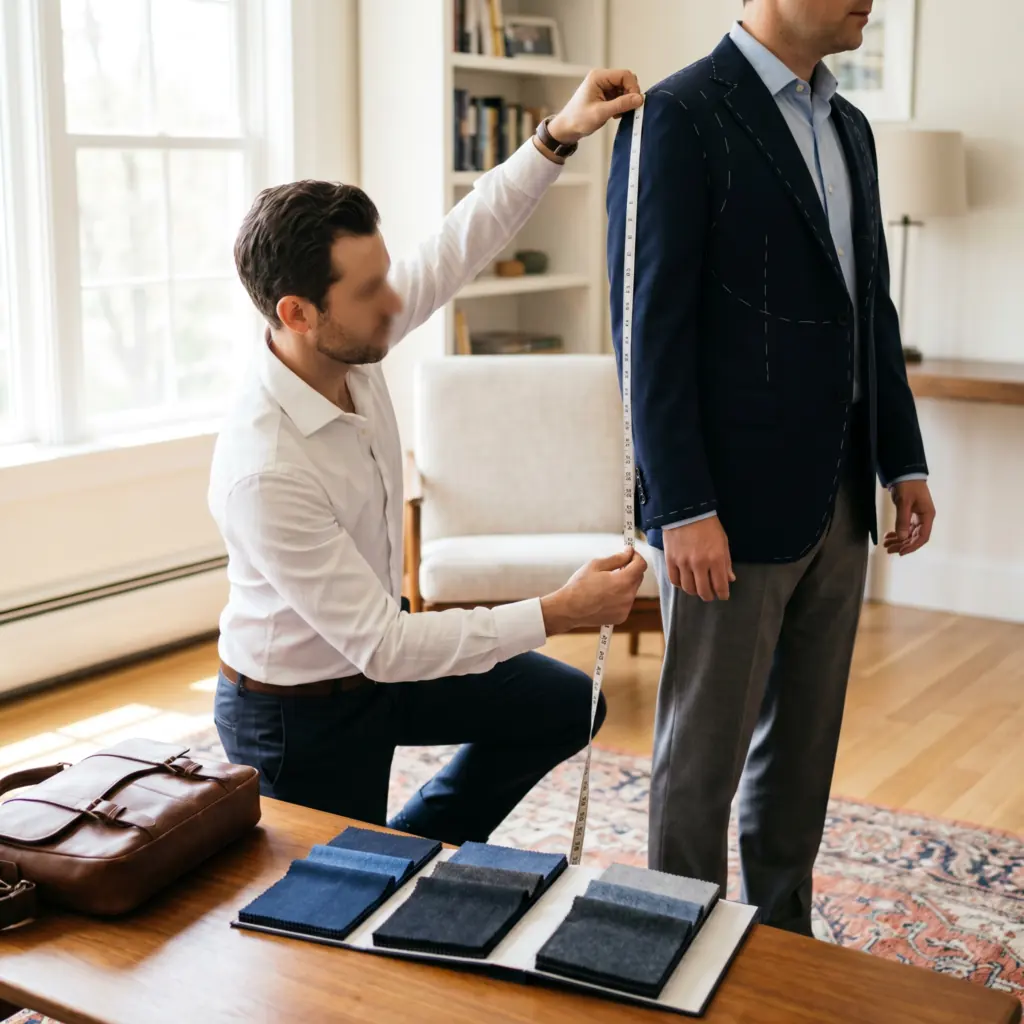
When you're ready to put this into practice, you can book a mobile fitting at your home or office with Brandon and get measured in person.
For a deeper look at why building to the pattern solves so many of these at once, see our breakdown of why made-to-measure beats off-the-rack in Kansas City.
A Real-World Example
A Kansas City executive came to us with a closet full of off-the-rack suits that “almost fit.” We did a fit audit on his favorite navy suit before recommending anything. Twelve points checked.
Shoulders, jacket length, and chest were fine. The seven other points all had identifiable problems. The collar gapped about a half-inch. The sleeve covered his entire shirt cuff. The waist was boxy with no suppression. The thighs were baggy. The break pooled on his shoes. The hem was too wide for his almond-toe oxfords.
Some of those could be fixed. We sent him to a good alterations tailor for the sleeves, waist, thigh taper, break, and hem, a few hundred dollars of work. The collar gap and the underlying shoulder construction stayed. The suit went from “almost fits” to “fits well for what it is.”
For his next suit, he came back for made-to-measure. The same twelve points were dialed in from the pattern, and the cost difference was less than he had been paying in alterations over the years.
Pro Tip From The Suit Doctor
When you try on a suit, do not just check the mirror. Move. Raise both arms. Reach forward like you are shaking hands. Sit down. Cross your legs. A suit that fits standing still but pulls when you actually use your body is not a suit that fits. Real fit accounts for the way you move through your day.
Frequently Asked Questions
What is the most important fit point on a suit? The shoulders. They cannot be altered after the fact, and a bad shoulder fit makes every other point look worse. Always start at the shoulders.
Can a tailor fix any fit problem? No. Shoulders, deep collar gaps, and dramatic jacket length issues are very limited or impossible to fix. Almost everything else can be adjusted within about an inch in either direction, but bigger problems usually point to needing a different size or a different suit.
How do I know if a suit is too tight in the chest? Button the middle button and look at the fabric around it. If you see an X-shaped crease radiating from the button, the chest is too tight. If the fabric lies flat, the chest fits.
Is “skinny” the same as “slim” for a suit? No. Slim follows the line of your body without binding. Skinny pulls and bunches because it is cut tighter than your actual shape. Skinny is a trend that often reads dated within a few years. Slim is timeless.
How much shirt cuff should show below the jacket sleeve? A quarter to three-quarters of an inch when your arms hang naturally. Less than that and the sleeve is too long. More than that and it is too short.
Should I size up for a “comfortable” fit? No. Sizing up makes a suit look loose and sloppy, not more comfortable. Comfort comes from cut and fabric, not extra fabric. A well-fitted suit in quality wool is more comfortable than an oversized one.
What does “drop” mean in suit sizing? Drop is the difference in inches between your chest measurement and your trouser waist. A six-inch drop is standard off-the-rack. Athletic builds often need an eight-inch drop, which is one reason off-the-rack rarely fits muscular men well.
How long should it take to spot a fit problem? About thirty seconds, once you know the twelve points. Walk through them in order: shoulders, collar, chest, length, sleeve, waist, vents, trouser waist, seat, thigh, break, hem.
Is a slight break or no break more modern? A slight break is the most universally flattering. No break reads more modern and slightly more fashion-forward but requires a clean trouser line and a confident shoe. Full break reads traditional.
Can I improve the fit of an existing suit? Yes, if the shoulders fit and the chest is close to right. A good alterations tailor can address sleeves, waist, thighs, break, hem, and most trouser points. A full alterations pass on a suit that needs everything usually runs a few hundred dollars.
Key Takeaways
- Twelve specific points decide whether a suit looks great or just okay.
- Shoulders cannot be altered, so they must fit first.
- Collar gap, X-creasing, sleeve length, and break are the most common problems.
- Most off-the-rack suits need three to five alterations to look right.
- Made-to-measure dials in all twelve from the pattern.
- Fit beats fabric, brand, and price every single time.
Get Your Fit Audited in Kansas City
You now have the full checklist that separates a suit that fits from one that almost fits. The next step is putting it to work, either on the suits you already own or on the next one you buy.
The Suit Doctor builds suits that hit all twelve points the first time.
- A fit audit on your current suits, point by point
- Custom and made-to-measure suits for business, weddings, and prom
- Convenient mobile fittings throughout the Kansas City metro
- Honest guidance on what alterations can fix and where custom makes more sense
Ready to get started? Learn how the custom suit process works in Kansas City, or book your fit consultation in Kansas City and let’s get your suits right.
The Suit Doctor | Custom and Made-to-Measure Suits for Men Who Take Their Look Seriously.
Get measured for a suit built around how you actually live.
See every service, from full custom builds to mobile fittings.