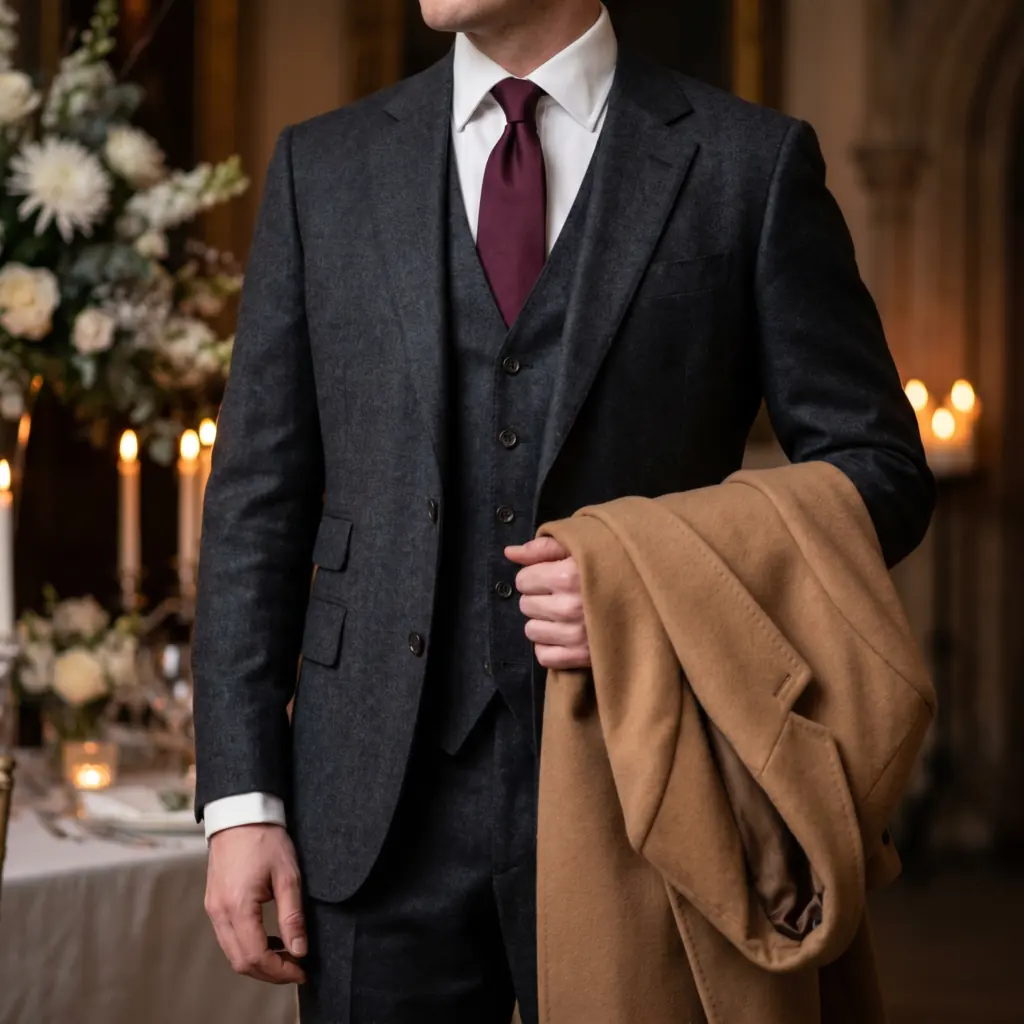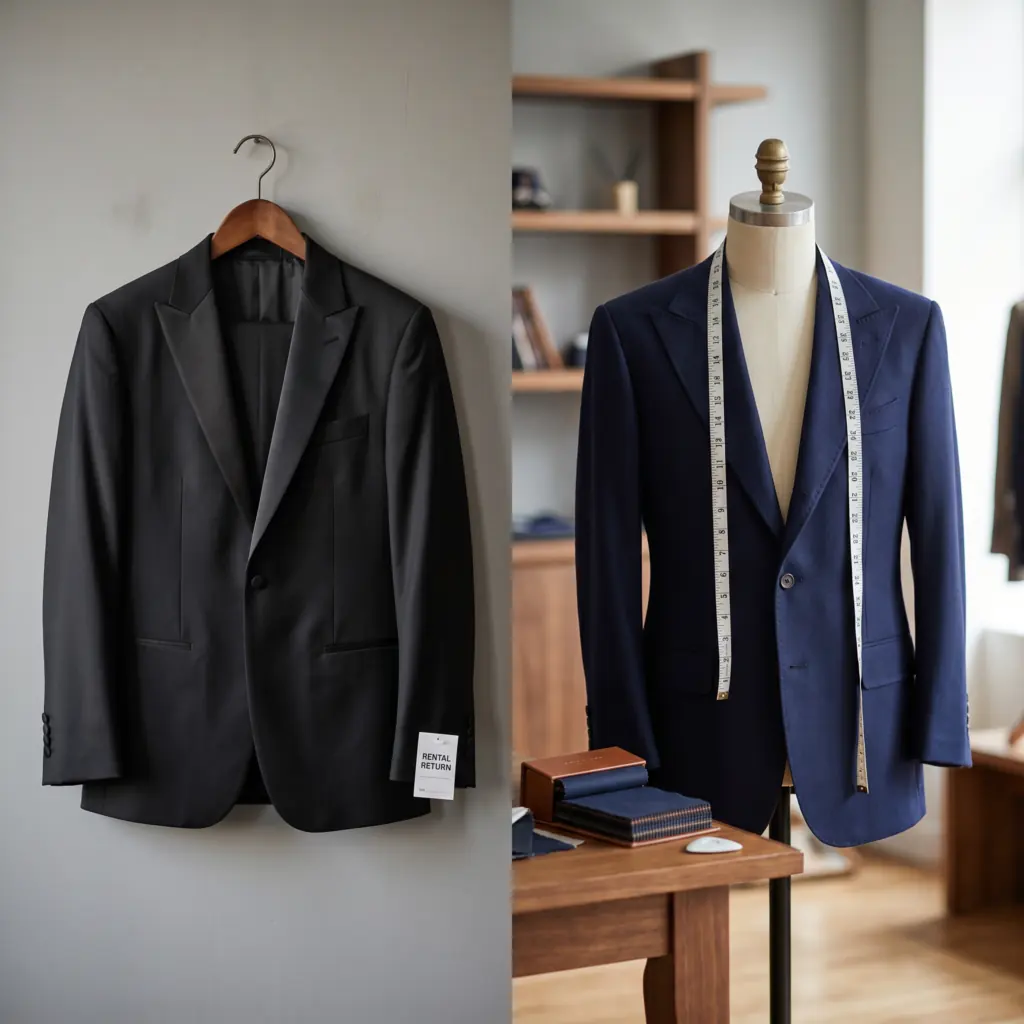
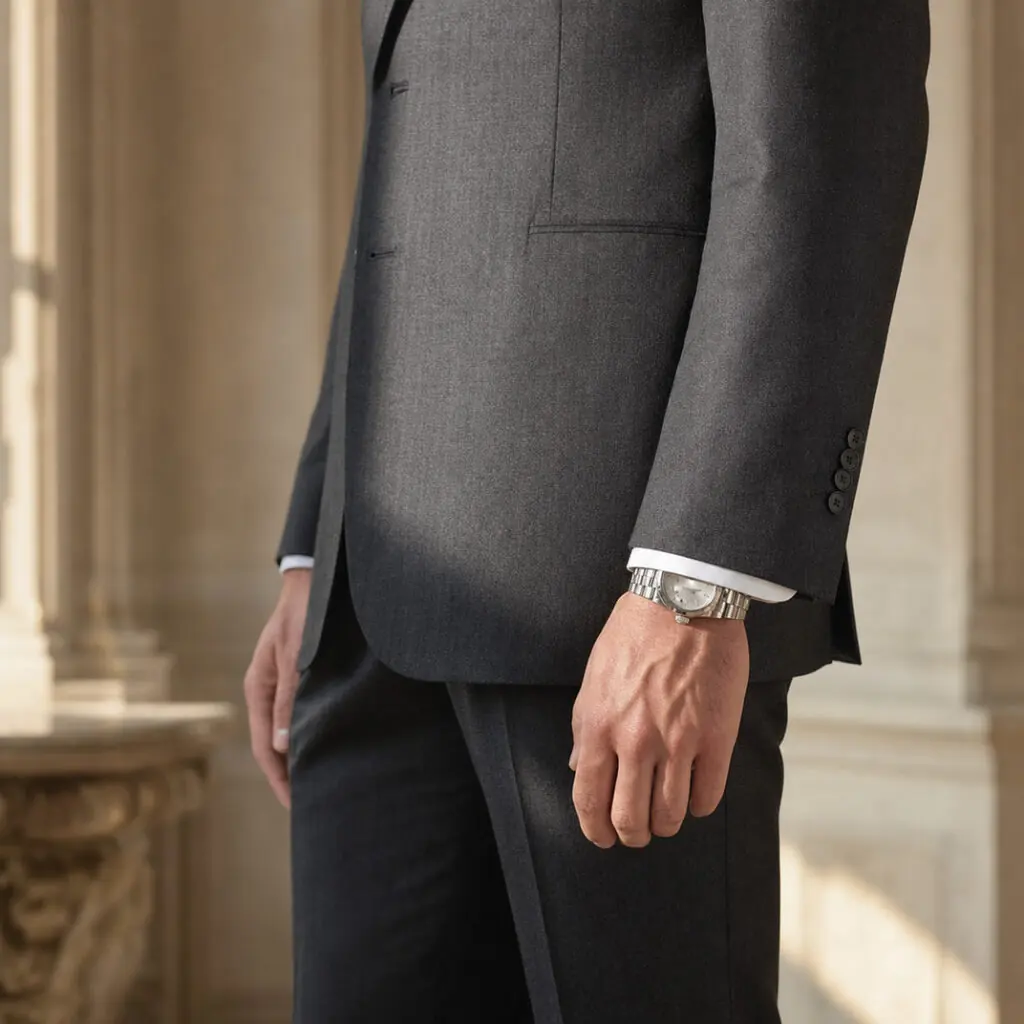
This guide covers how to get every length on your wedding suit exactly right: jacket length, sleeve length, and trouser break. You will learn the rules tailors actually use, how to check the fit yourself in the mirror, and the small details that separate a wedding suit that looks intentional from one that looks borrowed. The Suit Doctor fits grooms and groomsmen across the Kansas City metro every season, and these are the standards we hold every suit to before it leaves the studio.
TLDR: A wedding suit fits right when the jacket covers your seat and ends near the second knuckle of your thumb, the sleeve shows a quarter to a half inch of shirt cuff, and the trousers have a no break or slight break for a modern, photo-ready silhouette. Read on for the specifics that make these rules work for your body, your shoes, and your venue.
You will be in photographs your family looks at for the rest of their lives. The fit of your suit is the difference between photos that age well and photos that quietly date themselves the moment trends shift. Length is the single most photographable element of fit. A jacket that ends too high reads cropped. A sleeve that swallows your hand reads borrowed. Trousers that puddle on your shoes read sloppy.
This is the guide we give every groom in his first consultation. Print it, screenshot it, bring it to your fitting. These are the standards that will hold up in your photos a decade from now.
Wedding Suit Length Standards at a Glance
Before we go section by section, here is the quick reference card. We will explain each one in detail below.
- Jacket length (back): Target: Covers seat, ends near the gluteal fold
- Jacket length (front): Target: Ends near the second knuckle of your thumb
- Sleeve length: Target: Wrist bone, with 1/4 to 1/2 inch of shirt cuff showing
- Shirt sleeve: Target: Reaches the base of the thumb / wrist break
- Trouser break: Target: No break or slight break (modern), half break (classic)
- Trouser hem (back): Target: Just covers the heel, never drags
These targets work for a wedding because they photograph well, hold up across seated and standing poses, and look intentional in both indoor and outdoor light. Now let’s get into the why and the how.
How Long Should a Wedding Suit Jacket Be?
Jacket length is the foundation. If the jacket is wrong, everything underneath looks off, no matter how good the trousers or shoes are.
The Two Tests That Always Work
There are two industry-standard tests for jacket length. Use both, and your jacket will be right.
The seat test. Stand naturally with your arms at your sides. The bottom hem of the jacket should reach at least the bottom of your seat (the gluteal fold where your seat meets the back of your thigh). A jacket that ends above this point looks cropped. A jacket that hangs more than a half inch below the seat looks long and dated.
The thumb test. With your arms hanging naturally, the jacket hem should reach about the second knuckle of your thumb. For a modern silhouette, half an inch shorter is acceptable. For a traditional or formal cut, ending right at the second knuckle is correct.
For most men, both tests agree. If they disagree (say, you have a long torso or short arms), trust the seat test first. A jacket must always cover the seat in wedding photos.
Modern vs Classic Jacket Lengths
The cropped jacket trend from a few years back has pulled back. The current standard in 2026 is a balanced, classical length that covers the seat and ends at or just above the wrist bone of the hand.
- Classic: Typical length (5’10“ man): 30 to 31 inches from base of collar; Look: Traditional, formal, photographs well at any age
- Modern: Typical length (5’10“ man): 29 to 30 inches; Look: Slightly trimmer, contemporary silhouette
- Cropped (avoid): Typical length (5’10“ man): Under 28 inches; Look: Reads dated, exposes seat in photos
A wedding is not the place to chase a trend. Choose a length that will still look right in a photo on your child’s wall.
Jacket Length by Height: The Off-the-Rack Rule
Off-the-rack jackets map height to length codes (Short for 5’4“ to 5’7”, Regular for 5’8“ to 6’0”, Long for 6’1“ to 6’3”, Extra Long for 6’4“ and up). But that is a starting point, not a finish line. The thumb-and-seat tests still rule, and a tailor adjusts from there. With custom or made-to-measure, we measure your actual torso length and skip the bucket entirely. Our custom wedding suits in Kansas City are built to your real proportions, not to a size code.
Pro tip: Test jacket length wearing the shoes you will actually wear at the wedding. Heel height changes your posture and the way the jacket hangs by enough to matter in photos.
How Long Should the Sleeves Be on a Wedding Suit?
Sleeve length is the second most-watched detail in wedding photos because it sits right next to your hands, which are in almost every shot: the ring exchange, the first toast, the boutonniere pin.
The Cuff Rule: 1/4 to 1/2 Inch
The classic rule is that 1/4 inch to 1/2 inch of shirt cuff should show below the jacket sleeve when your arms hang naturally at your sides. This small reveal is the visible sign of proper fit. No cuff showing means your shirt is too short or your jacket sleeve is too long. More than 1/2 inch means the opposite.
For a wedding specifically, aim for the half-inch mark. It holds up best when your arms move (handshake, ring exchange, raising a glass) and photographs cleanly from any angle.
Where Each Sleeve Should End
The two sleeves work together. The shirt sleeve does one job, the jacket sleeve does another.
- Shirt sleeve: Where it should end: At the base of the thumb / wrist break
- Jacket sleeve: Where it should end: Just above the wrist bone
When both are right, the half-inch of cuff appears naturally. Most men try to fix this with the jacket alone. The truth is that a wrong shirt sleeve will sabotage even a perfectly tailored jacket.
The Bend Test
Want to see how this plays out in a real build? Explore our custom wedding suits page - it walks through fabrics, construction, and what to expect at your first appointment.
Once you have the suit on, do this in the mirror:
- Arms at your sides. Confirm the half-inch of shirt cuff is visible. The jacket sleeve sits just above the wrist bone.
- Arms bent at 90 degrees (handshake position). The shirt cuff should still be visible and not ride up to mid-forearm.
- Arms raised slightly (ring exchange position). Some cuff should still show. If the jacket sleeve swallows the cuff, the jacket sleeve is too long.
If you fail any test, the sleeve needs adjustment. This is one of the easiest tailoring fixes for a jacket and one of the most worth getting right.
French Cuffs vs Barrel Cuffs
If you are wearing French cuffs with cufflinks (more formal, common for black-tie weddings), you can show slightly more cuff: a half inch to one inch is acceptable, and the extra reveal lets the cufflink do its job. For standard barrel or button cuffs (most weddings), stay in the 1/4 to 1/2 inch range.
Pro tip: Wear the actual shirt you will wear at the wedding to your final fitting. Cuff thickness varies by shirt, and a thicker cuff changes the visible reveal.
How Long Should Wedding Suit Trousers Be? Understanding the Break
The trouser break is the small fold (or absence of fold) where the trouser hem meets the top of your shoe. It controls the entire bottom half of your silhouette and dictates whether you read modern, classic, or traditional.
The Four Break Options
- No break: Description: Hem ends just above the shoe, no fold; Vibe: Modern, clean, sharp; Best for: Slim cuts, contemporary weddings, shorter men
- Slight break (quarter): Description: Light brush of fabric on the shoe; Vibe: Modern with safety; Best for: Most grooms today
- Half break: Description: One soft horizontal fold on the shoe; Vibe: Classic, versatile; Best for: Traditional weddings, business-formal
- Full break: Description: Pronounced fold, fabric resting on the shoe; Vibe: Traditional, formal; Best for: Wider trouser cuts, vintage-inspired
For a wedding in 2026, the strong default is no break or slight break. The slight break is the safest choice for almost every groom: it photographs clean, holds up across seated and standing poses, and works whether you choose a slim or classic cut.
Why Trouser Break Matters in Wedding Photos
Wedding photographers shoot a lot of full-length and three-quarter shots. The bottom of your trousers is in every one of them. A full break that puddles on your shoes reads dated. A trouser that hangs an inch above your shoe (above no-break territory) reads borrowed. The slight break sits in the photographic sweet spot.
The Back of the Trouser Matters Too
A rule that almost no one mentions: the rear hem of your trouser should never drag below your shoe. If the front looks right but the back is dragging, the trouser is hemmed straight across when it should have a slight back-to-front slope. A skilled tailor builds in this slope so the back hem rests cleanly on the top of your heel while the front breaks at your preferred point.
Match Break to Cut
A simple rule: the slimmer the trouser, the shorter the break. A slim-cut wedding trouser looks best with no break or a slight break. A wider classic cut can handle a half or full break.
If your trousers have cuffs (turn-ups), go with no break or a slight break only. A full break with cuffs looks heavy and breaks the line of the leg.
Pro tip: Always wear your wedding shoes to your final fitting. Heel height of even a half inch can shift a slight break into a full break. Bring the exact shoes, not similar shoes.
Wedding Suit Fitting Timeline: When to Schedule
Length adjustments take time to dial in. Here is the timeline that works for most grooms.
- 6+ months out: Action: Consultation, fabric and style selection, initial measurements
- 4 to 5 months out: Action: First fitting, body measurements confirmed
- 8 to 10 weeks out: Action: Second fitting with construction in progress
- 3 to 4 weeks out: Action: Final fitting with shoes, shirt, and accessories
- 1 week out: Action: Pickup and last-look check
Rushing this timeline is the single biggest cause of wedding suit length errors. If you are inside three months and just starting, talk to us anyway. We have run many compressed timelines successfully, but the rule still applies: more time means more precision.
Need help planning the full timeline including groomsmen coordination? Schedule a Kansas City wedding suit consultation and we will map out every step from first fitting to final pickup.
How to Check Your Wedding Suit Length at Home
Use this checklist before your final fitting. Stand in front of a full-length mirror wearing the actual shoes, shirt, and accessories you will wear at the wedding.
- Jacket back hem. Does it cover your seat? It should reach the gluteal fold or just below.
- Jacket front hem. Hands at sides. Does the hem reach roughly your second thumb knuckle?
- Jacket sleeve. Just above the wrist bone? Half-inch of shirt cuff showing?
- Bend test. Arms at 90 degrees. Cuff still visible without riding up to mid-forearm?
When you're ready to put this into practice, you can book a mobile fitting at your home or office with Brandon and get measured in person.
- Shirt sleeve alone. With jacket off, does the shirt cuff hit the base of your thumb?
- Trouser break. What break did you choose? Does the front match your target? Does the back rest on top of your heel without dragging?
- Side profile. Turn 90 degrees. Are the proportions clean from the side? Is anything pulling or pooling?
If anything fails the check, call your tailor. Length issues are almost always fixable, but only if you catch them before the wedding week.
Common Wedding Suit Length Mistakes Grooms Make
A few patterns we see often enough to flag:
Choosing length without wedding shoes on. Shoes change everything below the waist. Always fit with wedding shoes.
Cropping the jacket too short to look trendy. Wedding photos outlive trends. Stay classical.
Letting the shirt sleeve be wrong. No jacket sleeve can fix a shirt sleeve that ends at mid-forearm or covers the hand.
Asking for a “modern slim” trouser without considering cut. A slim trouser with a half break looks awkward. Match break to cut.
Skipping the final fitting. Bodies shift in the weeks before a wedding. The final fitting catches it.
Treating groomsmen like grooms. Groomsmen suits should follow the same length standards, but variations in height and build need individual fittings. Our guide on whether the groom should match the groomsmen in Kansas City covers the coordination strategy in depth.
Frequently Asked Questions
How long should a wedding suit jacket be? A wedding suit jacket should cover your seat in back and end near the second knuckle of your thumb in front. For a modern cut, the hem can sit half an inch shorter, but it should never ride above the wrist bone or expose the seat.
How much shirt cuff should show with a wedding suit? A quarter inch to a half inch of shirt cuff should be visible below the jacket sleeve when your arms hang naturally. Half an inch is the safest target for wedding photos because it stays visible when you move.
What is the best trouser break for a wedding suit? For most grooms in 2026, a slight break is the best choice. It photographs clean, works with slim and classic cuts, and holds up across seated and standing poses. A no break suits sharper modern silhouettes, and a half break suits more traditional weddings.
Should I wear cuffed (turn-up) trousers to a wedding? Cuffed trousers add a touch of vintage formality and work beautifully with classic and tweed wedding suits. If you choose cuffs, go with no break or a slight break only. A full break with cuffs looks heavy.
Can a tailor fix a jacket that is too long or too short? Shortening is possible but limited by pocket position and the buttoning point. Lengthening is harder and depends on the seam allowance in the original construction. The best path is to get the length right in the first fitting, which is why custom or made-to-measure has an advantage for weddings.
How long before the wedding should my final fitting be? Three to four weeks before the wedding. Earlier risks body changes; later leaves no margin if something needs adjustment. If you are inside that window, reach out and we will work the timeline backward from your date.
Do groomsmen suit lengths need to match exactly? No. The standards are the same (seat covered, half-inch cuff, slight break) but each groomsman is measured individually. Identical-looking suits come from applying the same standards, not from forcing the same measurements.
What if I am between sizes for off-the-rack? Size up and tailor down. A jacket can be taken in but cannot be let out beyond the seam allowance. Better yet, skip off-the-rack for a wedding and go custom or made-to-measure.
Key Takeaways
- Jacket length: Cover your seat in back, second thumb knuckle in front. Modern cuts run half an inch shorter, never above the wrist bone.
- Sleeve length: Jacket sleeve just above the wrist bone. Shirt sleeve at the base of the thumb. A quarter to a half inch of cuff showing, half an inch is the wedding-safe default.
- Trouser break: No break or slight break is the modern wedding standard. Match break to cut. Never let the back hem drag.
- Fit with real shoes: Heel height shifts every length below the waist. Final fittings always happen with the actual wedding shoes.
- Timeline matters: Six months for the cleanest result. Three to four weeks before the wedding for the final fitting.
- Standards beat trends: A classical length holds up in photos for decades. Cropped silhouettes date quickly.
Ready to Get the Perfect Wedding Suit Length?
You now understand the standards that separate a sharp wedding suit from one that looks just-okay in photos. The next step is working with a tailor who measures, fits, and adjusts to these standards for every groom and groomsman who walks in.
The Suit Doctor specializes in wedding suits and groomsmen coordination across the Kansas City metro.
- Personalized fittings for groom and groomsmen
- Custom and made-to-measure construction
- Multiple fittings included to dial in every length
- Convenient mobile fittings for busy wedding parties
- A streamlined timeline that meets your wedding date
Ready to get started? Reach out to book your wedding suit fitting and let’s build the suit you will be proud of in every photo.
The Suit Doctor | Custom and Made-to-Measure Suits for Men Who Take Their Look Seriously.
Get measured for a suit built around how you actually live.
Fittings for grooms, groomsmen, and the whole wedding party.