


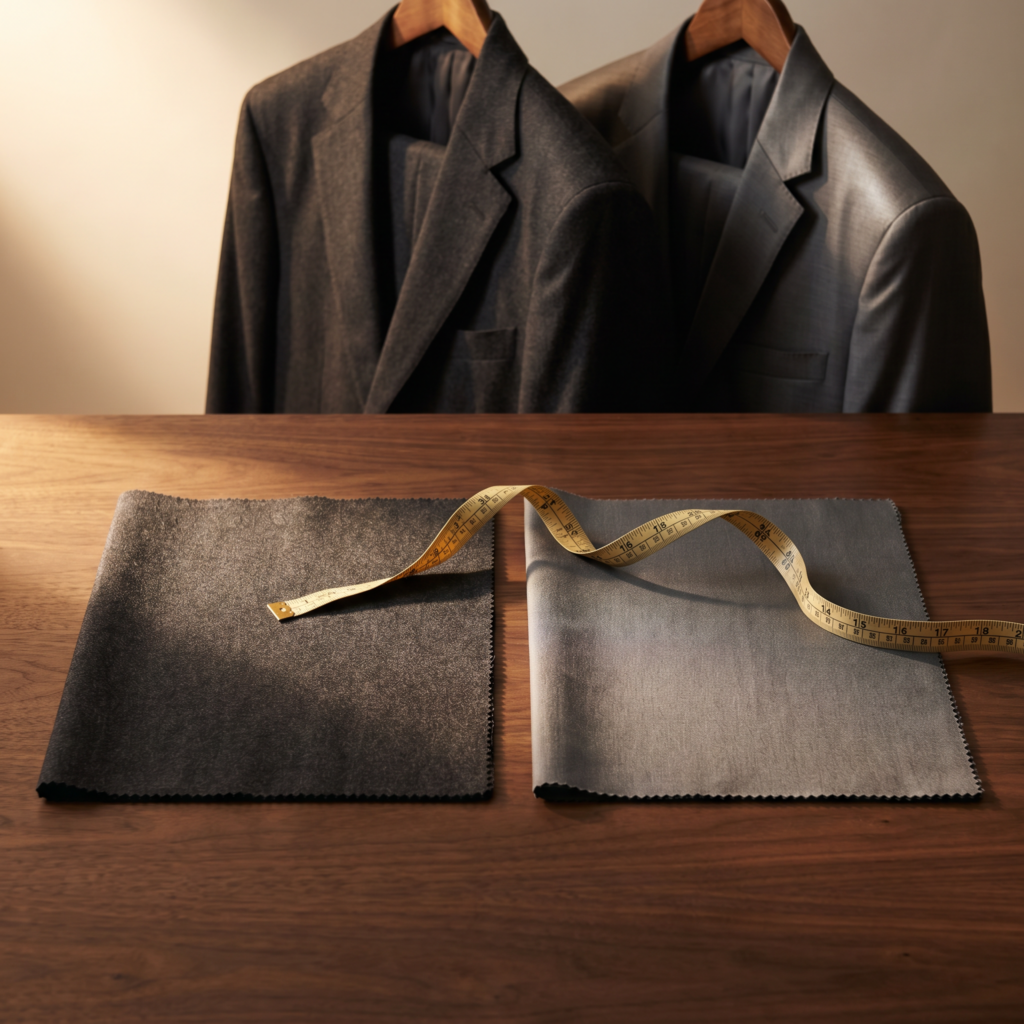
Wool wins for almost every professional suit you will buy in Kansas City, and the reason starts at the molecular level. Wool fibers are coiled springs of keratin protein that breathe, stretch, recover, and resist fire in ways polyester cannot match. Polyester is a petroleum-based plastic fiber that holds shape and costs less, but it traps heat, sheds microplastics in the wash, and tends to look shiny under bright lights. The Suit Doctor has fitted Kansas City professionals since 2020, and the fabric question still drives most of our conversations. This guide walks through the science, the trade-offs, and the honest cases where polyester or a blend earns its place.
TLDR: Wool outperforms polyester on breathability, drape, wrinkle recovery, longevity, and fire safety, which is why nearly every quality suit uses wool as its main fiber. Polyester is cheap, durable, and easy to wash, so it works for rental events, costumes, or rare-use suits where budget rules. Most ready-to-wear blends range from 55% to 99% wool, and higher wool content generally means a better-looking, longer-lasting suit. Care matters more than people think.
What these fabrics actually are
Before comparing two fabrics, it helps to understand what they are made of. Wool and polyester come from completely different worlds, one biological and one chemical, and that difference shows up in every property a suit owner cares about.
Wool: a coiled protein spring grown by sheep
Wool is built from keratin, the same protein family that forms hair, horn, and nails. Each fiber is a long protein chain twisted into a helix, the way a phone cord coils. The Australian Wool Education Trust and peer-reviewed work in the Biophysical Journal describe how that helix is held in shape by two types of chemical bonds: hydrogen bonds within the protein chain and disulfide bonds that cross-link separate chains. Think of it as a coiled spring with rivets along the side. That structure is why a wool fiber can stretch up to 30% of its length, then snap back when you let go. Your suit jacket survives a long flight or a long meeting because the fibers literally bounce back into shape.
Wool also has a clever architectural trick. Inside each fiber are two kinds of cells, called orthocortical and paracortical cells, arranged on opposite sides. They differ in length and chemistry, so the fiber bends naturally as it grows. That bend is the famous wool crimp, and it is what gives wool its loft, its insulating air pockets, and its springy hand.
The outside of a wool fiber is covered by overlapping scales called the cuticle. That cuticle gives the fiber a naturally water-repellent outer surface, while the inner core can absorb moisture vapor. (Note: raw wool also carries lanolin, a natural grease, but most lanolin is removed during scouring before fabric is woven. The finished fiber still has a naturally water-repellent outer surface while keeping its moisture-absorbing inner core.)
Polyester: tightly packed plastic chains
Polyester is short for polyethylene terephthalate, abbreviated PET. According to the Royal Society of Chemistry’s Essential Chemical Industry, PET is made by reacting two petroleum-derived chemicals, terephthalic acid and ethylene glycol, into long polymer chains. Those chains are loaded with stiff, flat benzene rings that stack tightly together, almost like a brick wall. That packing gives PET its high melting point, its strength, and its famous wrinkle resistance.
The fiber is produced by melting PET pellets, pushing the molten plastic through tiny holes called spinnerets, and then cooling and stretching the strands. The same plastic family makes water bottles. PET was first patented in 1941 by British chemists Whinfield and Dickson, and per Britannica, commercial fiber production started in the early 1950s with DuPont’s Dacron and ICI’s Terylene. By the 1960s, polyester was everywhere in clothing, including those notorious shiny disco suits.
Because polyester chains pack so tightly and carry no water-loving chemical groups, the finished fiber is strongly hydrophobic. Multiple textile reference sources put pure polyester’s moisture regain at only about 0.4%, compared to roughly 8.5% for cotton. In plain language, polyester barely interacts with water at all, which is why sweat tends to sit on the inside of a polyester garment instead of being absorbed into the fiber.
The six differences that matter for a professional suit
The lab-level details add up to six real-world differences you will feel every time you put on the jacket.
Breathability and moisture management
This is where the gap between the two fabrics is widest. The Woolmark Company states that wool can absorb up to 35% of its weight in moisture vapor before it feels wet and clings to the skin. The International Wool Textile Organization confirms the same figure, explaining that wool’s hydrophilic core draws in water vapor and releases it back into the air as conditions change. That is why a wool suit feels comfortable on a humid June afternoon at Loose Park and again in an air-conditioned reception hall an hour later.
Polyester does the opposite. With a moisture regain of nearly 0.4%, sweat has nowhere to go but onto your shirt or skin. In a Kansas City summer, where average July highs sit near 89°F and dew points routinely climb past 70°F, that translates into a damp, sticky feeling under the arms and across the back. Menswear retailer Black Lapel sums up the visible result on its blog: polyester suits often appear “stiff (like plastic)” and look shiny in bright light. At the same time, the wearer ends up “suffocating and sweating it out under that stuffy jacket.” We cite that observation as one industry voice among many; the underlying physics is the same picture the Woolmark and IWTO data describe from a neutral standpoint.
Drape and appearance
Drape is the way a fabric falls and folds over the body. Wool’s coiled, crimped fibers create a fabric with weight, body, and a soft return. The cloth follows the chest, breaks gracefully over the shoe, and resists looking flat. Worsted wool in particular gives that crisp lapel roll and clean trouser line that photographs well at a rooftop wedding at the InterContinental on the Plaza.
Polyester drapes poorly because the fiber is stiff and the cloth tends to be flat-faced. Under direct light, especially the LED panels common in modern offices and reception venues, cheap polyester catches glare on its smooth surface. That is the source of the telltale sheen most people associate with cheap suits. Friction points like elbows and seat seams also tend to develop shiny wear spots over time.
Wrinkle recovery
Polyester’s one honest advantage is wrinkle resistance. Those tightly stacked benzene rings resist deformation. Pack a polyester jacket in a duffel, and it comes out mostly smooth. Wool wrinkles more easily in the moment, but its keratin springs recover overnight. Hang a wrinkled wool jacket in a steamy bathroom,m and most of the t creases drop out by morning. So the question is not which fabric wrinkles less, but which one bounces back. Wool bounces back. Polyester does not need to bounce back because it never moved much in the first place, and that same rigidity is what makes it look stiff on the body.
Longevity and aging
A well-made wool suit ages slowly and gracefully. Apsley Tailors writes that, with proper care, a fully tailored wool suit “typically lasts 10-20 years,” with lighter-wear examples lasting longer still. The fibers’ natural elasticity means the jacket keeps recovering its shape even after thousands of wears. Wool also takes alterations well, so that a reputable tailor can adjust the suit as your body changes.
Polyester suits live shorter, harder lives. The fabric does not breathe, so body oils and odors build up, requiring frequent cleaning. The fibers are strong but inflexible, so the cloth eventually develops permanent shine at stress points and cannot be easily restored. When a polyester suit fails, it tends to fail visibly and all at once.
Flame resistance
This one matters more than people realize, especially for groomsmen near sparklers, candles, or fire pits. Per Woolmark Company and CSIRO testing data, wool will not ignite until the surrounding flame reaches 570-600°C, and its Limiting Oxygen Index (LOI) is 25.2%. LOI is the minimum oxygen concentration needed to keep a material burning, and atmospheric air is only about 21% oxygen. Because wool requires more oxygen than the air around it provides, it self-extinguishes once the flame source is removed. The fiber chars rather than melts, and that char layer further slows the spread.
Polyester behaves very differently. Industry data place polyester’s LOI between 20% and 22%, just at or below atmospheric oxygen, with ignition temperatures around 432 to 488°C. Worse, polyester melts before it burns. Jeanette M. Cardamone, a chemist at the USDA Agricultural Research Service, told Agricultural Research magazine in 2008: “Wool burns with a self-extinguishing flame and produces a soft ash that dissipates and will not lodge in open wounds. Synthetic materials, on the other hand, form hot, molten beads that can drip into a wound and cause trauma.” That is the reason military and aviation uniforms still rely on wool.
Environmental considerations
Wool is biodegradable, renewable on a roughly 12-month sheep-shearing cycle, and decomposes back into nitrogen and other nutrients in soil. Polyester is petroleum-based and does not biodegrade in any meaningful timeframe.
There is also the microplastic question. A 2022 peer-reviewed paper in the journal Materials (Šaravanja, Pušić, and Dekanić, doi:10.3390/ma15072683) reports that polyester fibers shed more microfibers in the wash than other common synthetics, and that polyester and polyamide together account for roughly 60% of global synthetic fiber production. The UK Marine Conservation Society notes on its campaign page that “the worst microplastic shedding culprit is polyester fleece, but nylon and polyester fabric are also high shedders,” and that woven polyester releases significant fibers into wastewater.
Recent research adds another wrinkle. A December 2025 report titled Spinning Greenwash, conducted by the Çukurova University Microplastic Research Group and published by the Changing Markets Foundation, tested 51 garments from Adidas, H&M, Nike, Shein, and Zara. Across the sampled items, recycled polyester clothing released about 12,000 fibers per gram on average, roughly 55% more than virgin polyester at about 8,028 fibers per gram. The authors are upfront that the sample is small and that a larger 2023 industry study found no statistically meaningful difference, so the science is still developing. The takeaway is not panic but realism: every polyester garment, recycled or not, sheds some plastic, and a wool suit does not.
The case for polyester: when it actually makes sense
Honest fabric advice has to admit polyester earns its place in a few situations. If you are buying a single suit you will wear two or three times in your life, like a one-off costume or a high school prom suit you will outgrow in six months, an inexpensive polyester or polyester-heavy suit may be the right call. The cost is low, wrinkle resistance is genuinely useful for storage between wears, and you are not asking the fabric to last a decade.
Polyester also works for some performance-driven garments where moisture management is engineered into the finish, such as caterer uniforms, theatrical costumes, or some travel blazers built around stretch. Budget polyester rentals can be a sensible choice for groomsmen who live in different cities and only need the suit for one ceremony.
What polyester does not do well is serve as the everyday cloth for a professional who wants to look pulled together at a downtown firm, present at a Plaza client lunch, attend a summer wedding at Mill Creek Park, and still look the part three years later. For that wardrobe, wool is the right answer almost every time.
Wool-polyester blends: where most buyers actually land.
Most suits in the real world sit somewhere on a spectrum between 100% wool and 100% polyester. Adding a small percentage of polyester to wool can increase wrinkle resistance, add a little stretch, and reduce shrinkage, which is why some quality mills offer blended performance fabrics. The trade-off is that breathability, drape, and that warm wool hand all decline as the polyester percentage rises.
There is no single industry standard for blend tiers. The Woolmark Company’s certification system recognizes 100% pure new wool, the Woolmark Blend logo for fabrics with 50% to 99.9% virgin wool, and the Wool Blend logo for 30% to 49.9% wool. Beyond that formal framework, tailors and retailers describe blends in informal ranges. The table below summarizes the conventions you will encounter when shopping, presented as a general guide rather than a strict rule.
| Wrinkle-resistant, low-cost, synthetic feel | Common positioning | What you typically get |
|---|---|---|
| 100% wool | Premium, made-to-measure, custom | Best drape, breathability, longevity, recovery |
| 85% to 99% wool | Quality off-the-rack and performance blends | Slight wrinkle and stretch boost; near-wool feel |
| 70% to 80% wool | Mid-range department store | Noticeable wrinkle resistance; some loss of drape |
| 55% to 65% wool | Budget tier | Easier care, reduced cost, less breathability |
| Under 50% wool | Mostly polyester suits | Wrinkle resistant, low cost, synthetic feel |
For a suit you will wear every week in Kansas City weather, we generally recommend staying at 100% wool when the budget allows, or, at a minimum, well above the 50% wool floor. The closer you stay to all wool, the more your suit will look, breathe, and last like one.
What this means for business, wedding, and travel suits
Different occasions stress fabric differently, so the right choice depends on how the suit will be used.
For a daily business suit worn to court appearances, client meetings, or a Country Club Plaza wealth-management office, a worsted wool in the 270 to 310 grams per square meter range is the workhorse. It handles spring and fall in stride, layers under a topcoat in winter, and looks crisp in conference room lighting. Super 110s or Super 120s wool offers a fine hand without sacrificing much durability for daily wear. You can see how this kind of suit comes together on our Kansas City business suits page.
For a Kansas City wedding, fabric weight depends on the season. A May or September ceremony at the InterContinental Plaza or a Loose Park outdoor event calls for tropical wool around 230 to 260 grams per square meter, often a high-twist worsted or hopsack weave that lets dew-point-heavy air pass through. A January wedding at Union Station calls for a heavier flannel or thicker worsted closer to 340 grams per square meter. Wool also takes well to the photography lighting these venues use, while polyester tends to flare under flash. Our Kansas City wedding suits page walks through the choices in more detail.
For travel suits, the temptation to go heavy on polyester for wrinkle resistance is understandable, but a high-twist worsted wool, sometimes marketed as “crease resistant” or “travel weight,” accomplishes the same thing while keeping you cool. A small percentage of wool blended with stretch fibers is reasonable here. If wrinkle resistance is the only goal, ask about high-twist constructions before defaulting to a synthetic.
How to care for a wool suit
A wool suit responds to care, and a little routine extends its life by years. The following checklist captures the recommendations from authoritative tailoring sources.
- Brush after wearing. Use a soft horsehair clothes brush to lift dust and surface fibers. Lords of Wool advises a quick brush, then storing the suit in a garment bag.
- Hang on a wide, shaped hanger. Senszio notes that a hanger wide enough to support the shoulders fully prevents the dimples and crease lines that thin wire hangers create.
- Steam, do not iron. Slater Menswear warns that heat from an iron, even at low settings, “can easily burn the fibers and upset the structure of the weave.” A handheld steamer removes wrinkles without risk.
- Dry clean sparingly. Lords of Wool puts it well: “Dry cleaning a suit can often shorten the life of a suit if you do it too often.” Their rule of thumb is to clean only when the suit is stained or smells, not on a calendar.
- Rotate at least two suits. Letting wool rest 24 to 48 hours between wears allows fibers to recover their shape and dry fully.
- Use cedar or lavender for moth protection. MothPrevention.com lists cedar as the leading natural deterrent, with lavender close behind. Treat them as repellents that discourage moths from settling, not as cures for an active infestation.
- Store in breathable cotton garment bags. Plastic traps moisture and can encourage mildew over long storage.
Done consistently, these habits keep a wool suit looking sharp for ten years or more.
A quick reference comparison
| Highly wrinkle-resistant | Wool | Polyester |
|---|---|---|
| Origin | Renewable protein fiber from sheep | Petroleum-based PET plastic |
| Breathability | High; absorbs up to 35% of weight in moisture vapor | Low; about 0.4% moisture regain |
| Drape | Soft, weighty, recovers naturally | Stiff, flat, often shiny under light |
| Wrinkle behavior | Wrinkles, then recovers with rest or steam | Highly wrinkle resistant |
| Longevity | 10 to 20 years with care | Shorter; visible wear at stress points |
| Ignition | 570 to 600°C; LOI about 25.2%; self-extinguishing | About 432 to 488°C; LOI 20 to 22%; melts and drips |
| Microplastic shedding | None | Sheds during washing; recycled may shed more |
| Best use | Daily professional wear, weddings, long-term wardrobe | Rentals, single-use events, true budget needs |
Frequently asked questions
Is a 100% wool suit always better than a wool blend? For most professional uses, yes. A 100% wool suit drapes better, breathes better, and ages better. A small polyester content can add wrinkle resistance or stretch, which may matter for a heavy travel schedule, but the trade-off is real. If you want the best look and longest life, all wool is the safer bet.
Will a wool suit be too hot for a Kansas City summer? Not if you choose the right weight. Tropical worsted wools in the 230 to 270 grams per square meter range, often woven with high-twist yarns, breathe better than most cottons and far better than any polyester. Many clients are surprised by how cool a well-chosen wool suit feels on a 90°F July afternoon.
Can I wash a wool suit at home? Generally, no. Wool can felt or shrink in agitation and warm water. Spot clean small marks with a damp cloth and mild soap, steam to refresh between wears, and take the suit to a quality dry cleaner only when it is genuinely soiled.
Why do some polyester suits look so shiny? The polyester fiber surface is inherently smooth and reflective, and tightly packed PET chains amplify that effect. Under bright office light or camera flash, the fabric catches glare, which is the “shine” most people associate with cheap suits. Wool fibers scatter light along their scaled surface, giving a softer, matte finish.
Are recycled polyester suits a greener choice? Possibly, but the picture is mixed. Recycled PET keeps bottles out of landfills, which is genuine progress. However, the December 2025 Spinning Greenwash study found that recycled polyester garments shed about 55% more microfibers than virgin polyester in tested samples, while a larger 2023 industry study found no significant difference. The science is still being debated, so we treat recycled polyester as a partial improvement rather than a full solution.
What blend percentage should I avoid for a long-wear suit? We generally steer clients away from suits that are less than about 70% wool if the goal is a wardrobe staple. Below that line, breathability, drape, and recovery noticeably decline. For a one-off or rental occasion, lower wool content can still be acceptable.
Key takeaways
- Wool wins on breathability, drape, longevity, recovery, and fire safety, thanks to its keratin-coil and crimped-fiber structure.
- Polyester is cheap and wrinkle-resistant, but it traps heat, looks shiny, melts when burned, and sheds microplastics in the wash.
- Blends above 85% wool can offer a useful nudge in wrinkle resistance or stretch with little downside; below 70% wool, the trade-offs grow quickly.
- Care matters as much as fabric: brush, hang, steam, rotate, and dry clean only when needed to extend a wool suit’s life by years.
- Kansas City weather rewards a small wardrobe of wool weights tuned to the season, from tropical worsted in summer to flannel in winter.
Talk to The Suit Doctor about the right fabric for your suit.
Choosing fabric well is easier with cloth in your hands and someone explaining what each weave will do for your build, your schedule, and your budget. The Suit Doctor has been guiding Kansas City professionals through that process since 2020,offeringh mobile fittings fittingfees crediteds toward your purchase) and free in-shop consultations. We carry wool from established mills, offer thoughtful blends for travel and performance needs, and make custom suits, wedding and groomsmen suits, sport coats, and custom shoes. For current pricing on any of our services, please get in touch with us during your Kansas City consultation for a firm quote, and we will help you build a wardrobe that fits your life.
The Suit Doctor: Custom and made-to-measure suits for Kansas City professionals since 2020.