If the idea of a mobile suit fitting sounds too convenient to be real, you are not alone. Many first-time buyers assume that if a tailor comes to them, something must be getting cut. Cheaper fabric, fewer measurements, a rushed process. That assumption is wrong, and this guide explains exactly why. A mobile suit fitting delivers the same construction, the same fabric sourcing, and the same precision as an in-store appointment. In some key areas, it actually delivers more.
TLDR: The quality of a custom suit is determined by the pattern, the canvas, the fabric, and the sewing. None of those change based on where the first measurements happen. Mobile fittings use the same workshop and the same mills as in-store fittings, and measuring in a familiar environment can produce more accurate results because your posture is natural. Keep reading for the full breakdown.
The Real Fear Behind “Mobile” (And Why It Is Unfounded)
Let’s name the concern directly. When someone hears “mobile suit fitting,” the mental image is often a step down from a traditional shop. Something faster, cheaper, less serious. Maybe a guy with a tape measure and a catalog instead of a real tailor with decades of expertise.
That fear comes from a reasonable place. In most industries, convenience does trade off against quality. Fast food is faster but worse. Urgent care is quicker but less thorough. So the assumption that a mobile tailor is somehow a “lite” version of the real thing makes intuitive sense.
But in custom tailoring, the assumption falls apart. Here is why.
What Actually Changes: Location, Not Craft
The quality of a custom suit lives in the workroom, not the fitting room. The distinction between bespoke, made-to-measure, and off-the-rack is defined entirely by how the garment is cut and constructed: how the pattern is created, whether canvas or fused interlining is used, what mills supply the fabric, and how the sewing is executed. None of those factors have anything to do with whether the first measurements were taken in a showroom or in your living room.
When you book a mobile fitting with The Suit Doctor, the consultation happens at your home, office, or event venue. Everything after that, the pattern work, the fabric cutting, the canvas construction, the sewing, the finishing, happens in the same workshop, using the same methods and the same materials as any in-store service. The 4 to 6 week made-to-measure timeline is identical because the production process is identical.
Think of it this way: a doctor who makes house calls does not use a different stethoscope. The expertise travels with the professional, not the building.
Why At-Home Fittings Can Be More Precise Than In-Store
This is the part that surprises most people. A mobile fitting does not just match in-store quality. In several measurable ways, it can exceed it.
Your Posture Is More Honest at Home
When you stand in an unfamiliar showroom with other customers around, your body subtly tenses. You straighten up a little more than usual. You hold your shoulders differently. You may not even notice it happening. But your tailor does, because those small postural shifts affect every measurement from shoulder slope to jacket length.
Studies on environmental familiarity consistently show this effect. Familiar surroundings with recognized cues produce calmer physiological responses, including lower heart rate and reduced muscle tension. When your body is relaxed, your posture reflects how you actually stand and move in daily life, which is precisely the posture your suit needs to be built around.
A veteran mobile tailor with over 30 years of experience describes this directly: the best measurements come from clients who are completely relaxed in familiar surroundings, where their natural posture emerges without tension.
Real Lighting, Real Shoes, Real Context
In a showroom, you are standing under fluorescent lights in whatever shoes you happened to wear that day. At home, your consultant sees you in the actual lighting where you get dressed, evaluates fabric against your real environment, and measures you in the dress shoes you will actually pair with the suit.
As one doorstep tailoring service explains, when a garment is fitted in real lighting, in your usual shoes, and in your natural posture, the tailor can see details that shop fittings often miss. That contextual accuracy carries through every stage of construction.
The Things a Tape Measure Cannot Capture
The most important fit factors are not numbers on a tape measure. Shoulder slope (one shoulder almost always sits lower than the other), forward lean, neck placement, arm rotation, and weight distribution are all evaluated visually during the fitting, not measured with a number. These observations are more accurate when your body is in its natural state rather than performing for an unfamiliar room.
Construction and Materials: Same Standards, Different Address
Let’s address the construction question head-on, because this is where the “mobile = cheap” fear usually lives.
The Suit Doctor uses the same construction standards regardless of where the fitting happens. That means half or full canvas construction (not fused interlining), premium wool from Italian mills like Vitale Barberis Canonico and Loro Piana, and the standard 4 to 6 week made-to-measure timeline. Mobile is not an excuse for fast fashion. The timeline exists specifically to protect the quality of the finished garment.
If you want to understand how the custom suit process works from measurement through delivery, the steps are the same whether your first appointment happened in a shop or at your kitchen table. The workroom does not know or care where the measurements were taken. It only cares that they are accurate, and a relaxed client in a familiar environment gives the most accurate starting point possible.
Myth vs Reality: Mobile Suit Fittings in Kansas City
| Common Fear | What People Assume | What Actually Happens |
|---|---|---|
| “Mobile means lower quality” | Cheaper materials, rushed work | Same mills, same workshop, same timeline as in-store |
| “At-home is less precise” | Fewer measurements, less attention | 30+ measurements plus posture evaluation in a natural environment |
| “Convenience means rushed” | One-week turnaround, corners cut | 4 to 6 week MTM timeline protects construction quality |
| “In-store tailors are better” | Only beginners do mobile | Mobile fittings handled by the same expert consultants |
| “It is more expensive” | Premium for the house call | Same pricing as in-store; no showroom overhead to pass along |
Real Scenario: From Skeptical to Converted
Michael is a financial advisor in Overland Park who assumed mobile fitting was a gimmick. He had always gone to a traditional tailor downtown, spending half a Saturday on the trip. When his schedule got too packed before a major conference, he tried a mobile fitting as a last resort.
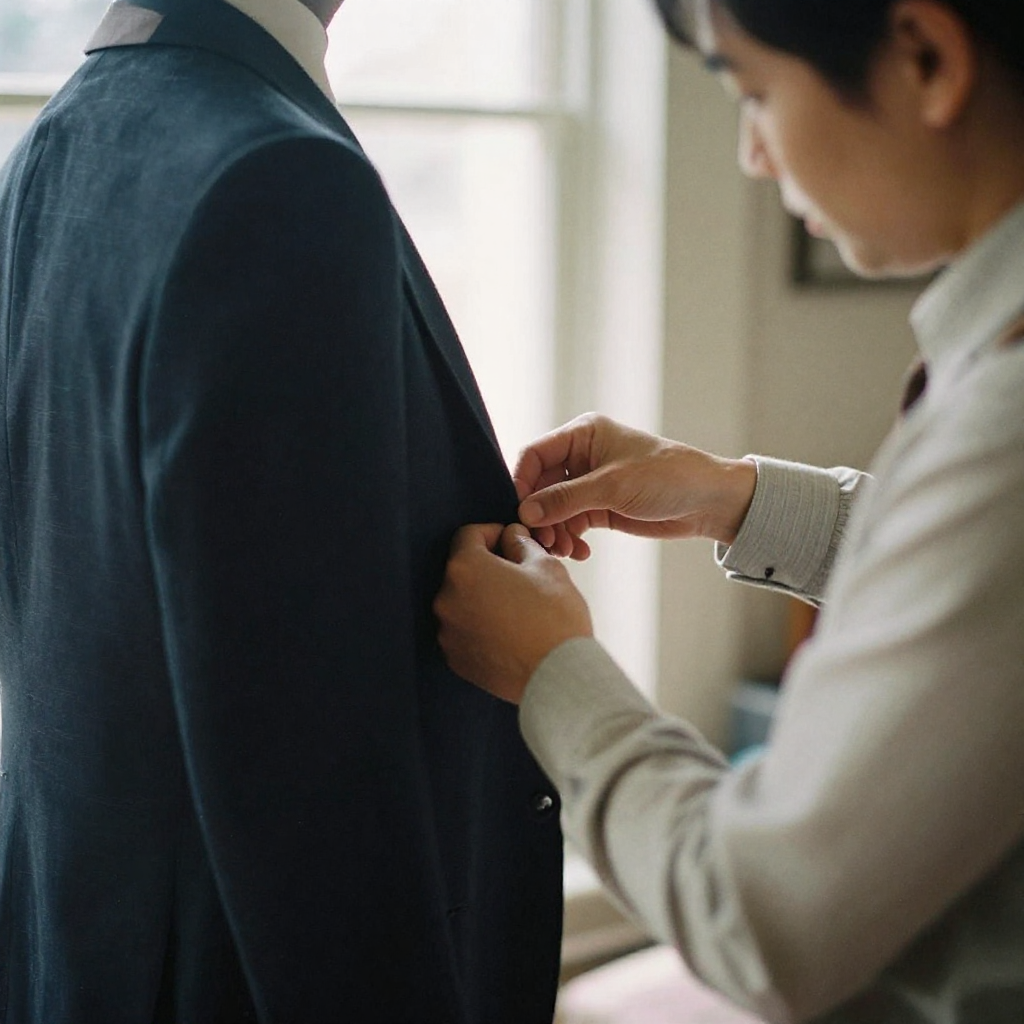
His consultant arrived at his home office on a Thursday evening, spent 20 minutes talking through the event and his daily wardrobe, presented fabric swatches he could evaluate under his own lighting, and took 35 measurements while he stood in his usual dress shoes on his own hardwood floor. The suit arrived in five weeks. The fit was the best he had ever experienced, and he later realized it was because the measurements captured how he actually stands and moves, not how he stood in a showroom trying to look put-together.
He has not gone back to an in-store fitting since. His most recent order was a Kansas City groom and groomsmen fitting for his brother’s wedding, conducted at the groom’s home with all four groomsmen measured in a single session.
Who Should Consider Mobile Over In-Store
Mobile fittings are built for people who value their time as much as their appearance. That includes the executive whose calendar does not have a two-hour gap for suit shopping, the remote worker who does not want to burn a commute day on errands, the groom coordinating fittings for a wedding party across multiple schedules, and the professional who simply prefers a private, one-on-one experience over a public showroom.
It also includes anyone who has felt uncomfortable in a traditional suit shop. If you have ever walked into a showroom and felt like you were being judged, rushed through a fitting, or pressured into a purchase, a mobile appointment removes all of that. The conversation happens on your turf, at your pace, with no one else in the room.
If you have been putting off a custom suit because the process seemed like too much work, a mobile fitting removes every logistical barrier except the decision itself. For guidance on choosing the right business suit for your career stage, The Suit Doctor’s team handles that conversation during the consultation itself.
Frequently Asked Questions
Q: Is a mobile fitting really as good as an in-store fitting? Yes. The construction, fabric sourcing, measurement process, and timeline are identical. The only difference is location, and that difference often works in the client’s favor because familiar surroundings produce more natural posture and more accurate measurements.
Q: How do I know corners are not being cut on construction? The Suit Doctor uses half or full canvas construction and premium Italian mill fabrics regardless of where the fitting takes place. The 4 to 6 week production timeline is itself a quality safeguard. Suits built in one or two weeks are cutting corners. A proper timeline is not.
Q: What happens if the suit is not perfect at delivery? Minor finishing adjustments at the delivery fitting are standard and expected. Your consultant checks every fit point, from shoulder seam to trouser break, and makes corrections on the spot. Quality custom suits also include seam allowances for future adjustments.
Q: How many measurements do you actually take? A complete fitting involves 30 or more measurements plus visual evaluation of posture, shoulder slope, arm rotation, and weight distribution. These observations are just as important as the numbers.
Q: Are mobile fittings more expensive than in-store? No. The Suit Doctor’s pricing is the same regardless of location. There is no upcharge for the house call.
Q: Can mobile fittings handle a full wedding party? Absolutely. Group fittings for grooms and groomsmen are one of the most common mobile appointments. Everyone gets measured in a single session at one location, which is far more practical than coordinating multiple showroom visits.
Key Takeaways
Quality lives in the workroom, not the fitting room. The pattern, canvas, fabric, and sewing determine your suit’s quality. None of those change based on where the first measurements happen.
Familiar environments produce better measurements. Natural posture, real lighting, and your actual shoes all contribute to a more accurate starting point for construction.
The timeline is the quality safeguard. A 4 to 6 week production window exists to protect construction standards. Mobile fittings do not compress that timeline.
Mobile is not a budget alternative. It is the same service, same pricing, and same expertise delivered in a smarter format for people who refuse to compromise on quality or time.
Ready to See the Quality for Yourself?
You now understand that a mobile suit fitting does not sacrifice anything. Same fabric mills. Same canvas construction. Same expert consultants. Same timeline. The only thing that changes is where you stand when the tape measure comes out, and that change actually works in your favor.
The Suit Doctor brings the complete custom tailoring experience to clients across Kansas City. Every mobile fitting includes expert consultation, premium fabric selection, 30+ precision measurements, and a guided process from start to finish.
The Suit Doctor offers:
- Mobile fittings at your home, office, or event venue
- Same construction standards and pricing as in-store
- Made-to-measure suits for business, weddings, prom, and special events
- Premium fabric from top Italian mills
Ready to get started? Visit thesuitdoctor.com or schedule your Kansas City mobile suit fitting today.
The Suit Doctor | Custom and Made-to-Measure Suits for Anyone Who Takes Their Look Seriously.