Your business suit shapes how colleagues perceive your competence, how clients judge your credibility, and how you feel walking into high-stakes meetings. Research from Princeton University found that people are judged on appearance within a tenth of a second of seeing someone. That’s 100 milliseconds. Before you shake hands or say a word, your appearance has already spoken for you.
This guide covers everything you need to know about selecting a business suit that works as hard as you do: fit fundamentals, fabric choices, color strategy, and building a professional wardrobe that serves your career goals.
TLDR: Start with a navy suit as your foundation, followed by charcoal gray. Fit matters more than brand or price. Look for wool fabrics in the Super 100s-120s range for the best balance of durability and comfort. Avoid black suits for daily business wear. Read on for the complete breakdown.
Why Fit Matters More Than Brand, Price, or Fabric
Here’s the truth that expensive marketing campaigns don’t want you to hear: a well-fitted $500 suit will always outperform a poorly fitted $2,000 suit. Every time.
From the viewer’s perspective (your manager, client, or interviewer), they’re seeing how clean and intentional the lines look, whether the shoulders and sleeves are right, and whether your overall appearance suggests discipline and attention to detail. They’re not checking the label inside your jacket.
This is why fit should be your first priority, not your last. A modestly priced, well-cut suit in solid navy projects more professionalism than a trendy designer suit that pulls at the button or puddles at the ankle.
Fit is your real status symbol.
Understanding Business Suit Fit: A Complete Breakdown
Before considering color, fabric, or brand, you need to understand what proper fit actually looks like. Each element builds on the others.
Shoulders: The Non-Negotiable Foundation
Shoulder fit cannot be corrected by alterations without essentially rebuilding the entire jacket. This makes shoulders your first and most critical checkpoint.
The jacket’s shoulder seam should sit exactly where your natural shoulder ends, not hanging over and not cutting in. The sleeve should fall cleanly from the shoulder with no dents, ripples, or divots at the sleeve head.
The wall test: Press your shoulder against a wall. The wall should contact your arm, not the jacket padding. If padding hits first, the shoulders are too wide.
If the shoulders don’t fit, walk away. This is the one area you should never compromise on, no matter how much you like the fabric or the price.
Sleeve Length: The Detail That Separates Professionals
Jacket sleeves should end at the wrist bone, showing approximately a quarter to half inch of shirt cuff. This small detail separates well-dressed professionals from everyone else.
Too-long sleeves make you look like you borrowed the jacket from someone larger. Too-short sleeves look awkward and cheap. The good news: sleeve length is one of the easiest and most affordable alterations, so don’t let imperfect sleeves disqualify an otherwise well-fitting suit.
Jacket Length and the Button Test
Your jacket should roughly cover the seat without dropping far past it. From the side, the hem often lines up somewhere between mid-hand and knuckles with your arms relaxed at your sides. A quick self-check: you should be able to curl your fingers under the jacket hem.
The front should shape slightly at the waist, creating a clean silhouette that’s neither boxy nor aggressively hourglass.
The button test: When buttoned, the jacket should not form an “X” of tension lines across the button. You should be able to slip a flat hand between your chest and the jacket comfortably. If fabric pulls or bunches, the jacket is too tight through the body.
Trouser Fit and Break Options
Business suit trousers should sit at or near the natural waist (around the navel), not low on the hips like casual pants. The seat and thighs should be clean with enough room to sit without pulling or horizontal creases.
The “break” refers to how the trouser leg interacts with your shoe:
Slight break (recommended for business): The hem just touches the top of the shoe with a small crease in the front fabric. This is the most versatile option for professional settings.
No break: The hem barely kisses the shoe with no fold, showing more ankle in motion. This reads as more modern but can feel too casual in conservative industries like finance or law.
Full break: A deeper fold on the front of the leg. This can look dated or sloppy if overdone, though some traditional dressers prefer it.
| Fit Element | Correct Fit | Signs of Poor Fit |
|---|---|---|
| Shoulders | Seam ends exactly at shoulder bone | Seam droops past shoulder or pulls inward |
| Chest | Lies flat when buttoned | X-shaped pulling at button, excess fabric billowing |
| Sleeves | Shows 1/4″ to 1/2″ shirt cuff | Shirt cuff hidden or 1″+ of cuff showing |
| Jacket length | Covers seat, fingers curl under hem | Jacket rides up past seat or extends past knuckles |
| Trouser break | Slight fold at shoe | Fabric pooling on shoe or high-water appearance |
How to Choose Your First Business Suit Color
The color of your first business suit sets the foundation for your entire professional wardrobe. Choose strategically, and you build options for years. Choose wrong, and you limit yourself before you start.
Navy: Your First Suit, Period
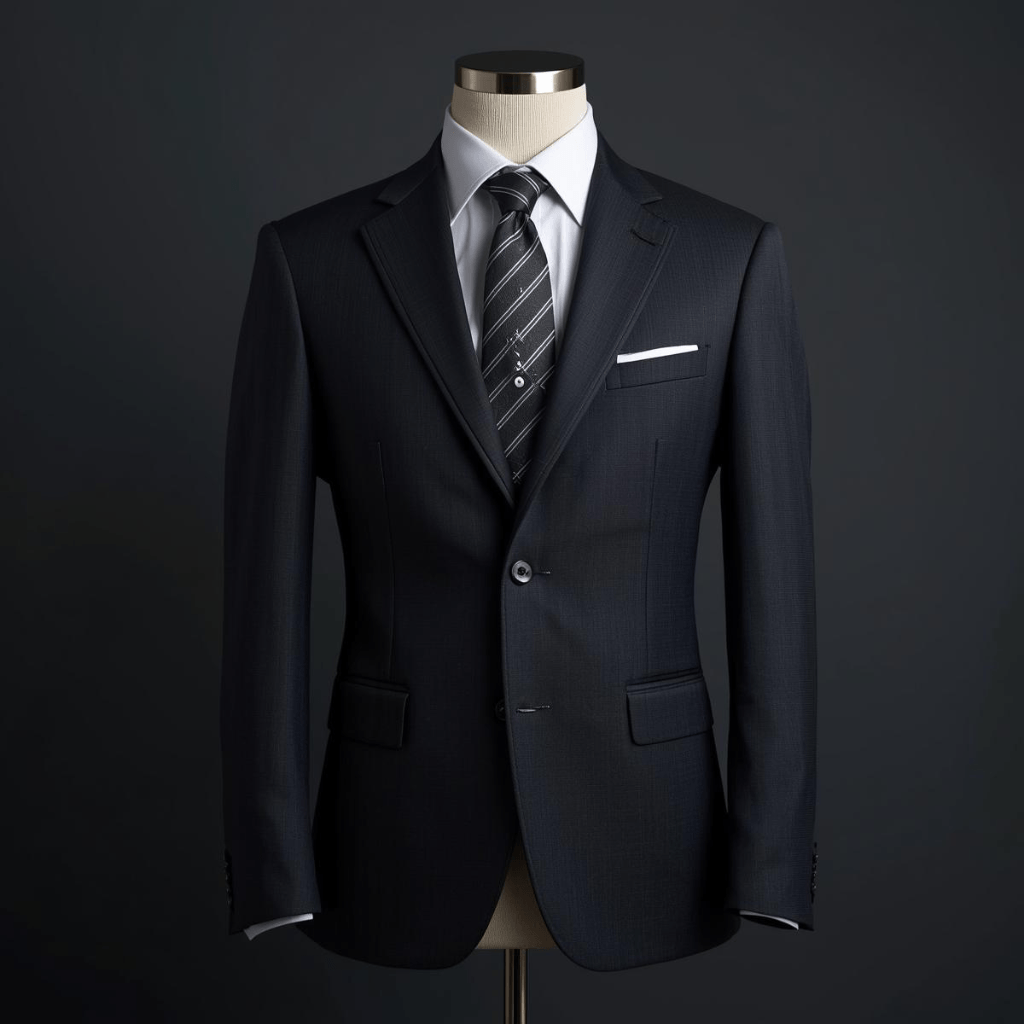
Navy should be your first business suit. Not because it’s safe, but because it’s strategically versatile across virtually every professional situation.
Navy signals trustworthiness and approachability while maintaining full professionalism. It works across almost all shirt and tie combinations. It transitions from boardroom presentations to client dinners to networking events without missing a beat. And critically for the modern professional, navy photographs well for headshots and video calls.
For maximum versatility, choose a darker navy. Midnight navy works for formal presentations, client meetings, interviews, and more relaxed Fridays. It reads as serious without the severity of black.
In conservative industries like finance, law, and consulting, navy is effectively non-negotiable as your foundation piece.
Charcoal Gray: Your Strategic Second Suit
Once you have navy covered, charcoal gray becomes your next investment. This combination gives you rotation options and prevents colleagues from assuming you own exactly one suit.
Charcoal carries slightly more formality than navy. It projects seriousness and authority while pairing well with white, light blue, pink, and patterned shirts. Together, navy and charcoal cover virtually every professional situation you’ll encounter.
Why Black Suits Are a Business Mistake
Black suits belong at formal evening events, funerals, and black-tie occasions. They do not belong in your daily business rotation.
In daytime business settings, black reads as too formal, too severe, or like you’re dressed for a memorial service. It’s not a versatility issue; it’s a context issue. Black is traditionally associated with evening wear rather than daytime professional environments.
Finance professionals, lawyers, and corporate executives overwhelmingly choose navy and charcoal for daily wear for exactly this reason. Black also shows lint, dust, and wear patterns faster than navy or charcoal, requiring more maintenance.
The exception: Certain industries (fashion, entertainment, some creative fields) operate by different rules. Know your specific environment before deviating from navy and charcoal as your foundation.
| Color | Best For | Avoid For |
|---|---|---|
| Navy | Interviews, client meetings, daily office wear, video calls | Black-tie events |
| Charcoal | Presentations, negotiations, conservative industries | Very casual creative environments |
| Black | Formal evening events, funerals, black-tie occasions | Daily business wear, job interviews |
| Medium Gray | Third or fourth suit, less formal offices | First business suit purchase |
| Patterns | Fifth suit after solid foundation established | First or second business suit |
Business Suit Fabrics: What Super Numbers Actually Mean
Fabric determines how your suit feels, how it drapes, how long it lasts, and how it responds to daily wear. Understanding the basics helps you make smarter investments and avoid marketing traps.
Wool: The Business Suit Standard
Wool is the gold standard for business suits. It breathes in heat, insulates in cold, drapes beautifully, resists wrinkles naturally, and maintains its shape over time. Most quality business suits use worsted wool, which has been combed to create smooth, parallel fibers for a clean, polished appearance.
Seasonal considerations:
- Lighter cloth (around 8-10 oz) breathes better in warm weather but can show wrinkles more easily
- Heavier cloth (around 12-14 oz) holds shape and drapes well in cooler climates
- Many mills offer “four-season” weights that work in both heated offices and mild climates, ideal for an all-around career suit
Super Numbers: Cutting Through the Marketing
Super numbers (Super 100s, 120s, 150s, etc.) describe the fineness of the wool fiber. The International Wool Textile Organisation sets global standards for wool quality in suit fabrics, connecting Super numbers to precise micron measurements. Higher numbers mean finer, thinner fibers that feel softer and drape more elegantly.
But here’s what the marketing doesn’t tell you: higher Super number is not automatically “better” for a career suit.
Finer fabric feels luxurious but is often less durable and more wrinkle-prone. For regular office wear, you need fabric that can handle your actual life, not fabric that looks amazing for three months.
Here’s the practical breakdown:
Super 100s: The workhorse business fabric. Durable, good for frequent wear, and perfectly professional. Many successful executives wear Super 100s daily without apology.
Super 110s-120s: The sweet spot for professionals. These fabrics balance comfort, refinement, and durability. They feel noticeably softer than Super 100s while still handling daily wear well. This is the range most business professionals should target.
Super 130s-150s: More luxurious with beautiful drape and softness. Best for executives who aren’t commuting on crowded trains or sitting in cars for hours. These fabrics show wear faster with heavy use. Great for special days or occasional wear.
Super 160s and above: Luxury showpiece territory. Beautiful but fragile. Not ideal for everyday office use due to fragility. Reserve for special occasions where you won’t be sitting for eight hours.
The bottom line: For your primary business suits, Super 100s-120s is often the smartest choice. Save the ultra-fine fabrics for suits you’ll wear less frequently.
Construction: What’s Inside Matters
How a jacket is constructed affects how it drapes, moves, and ages over years of wear.
Full-canvas construction: A layer of horsehair canvas is stitched (not glued) between the outer fabric and lining. This allows the jacket to mold to your body over time and creates natural drape. Full-canvas suits cost more but age better and last longer.
Half-canvas construction: Canvas in the chest and lapels, fusing (glue) in the lower portions. A good middle ground between quality and value for most professionals.
Fully fused construction: The interlining is glued to the outer fabric throughout. Cheaper to produce but doesn’t drape as naturally and can bubble or separate with dry cleaning over time.
For business suits you’ll wear regularly, half-canvas or full-canvas construction justifies the investment in longevity and appearance.
Made-to-Measure vs. Off-the-Rack: Making the Right Choice
Every professional considering a business suit faces this question. Understanding the real differences helps you make the right choice for your situation.
Off-the-Rack Suits
Off-the-rack suits are mass-produced to a standard set of sizes (38R, 40L, etc.) designed around an “average” body shape that rarely matches anyone perfectly.
Advantages:
- Lower upfront cost
- Immediate availability
- Easy to try on multiple options in one shopping trip
Limitations:
- Limited fabric and style options per season
- Designed for standardized proportions that may not match your body
- Usually require alterations (hemming, sleeve length, waist/seat adjustments)
- Limited ability to solve difficult fit issues like sloped shoulders, athletic builds, or significant drop between chest and waist
Even well-selected off-the-rack suits typically need $75-150 in alterations for a proper look. Factor this into your true cost.
Made-to-Measure Suits
Made-to-measure suits start from a base pattern that is adjusted using your specific body measurements and posture observations. You choose fabric, lapels, vents, pockets, lining, and other design details.
Key advantages for career professionals:
- Better shoulder, chest, and posture handling than off-the-rack plus alterations
- Cleaner silhouette that looks intentional rather than “almost right”
- More durable construction and fabric options than many fashion-focused retail brands
- Consistent fit over time when you reorder from the same tailor
- Full customization of styling details
The tradeoff: Made-to-measure requires at least one initial measuring session and typically 4-8 weeks production time.
Not sure which direction fits your needs? A custom suit consultation in Kansas City removes the guesswork. Expert measurement, posture evaluation, and fabric guidance ensure you invest in a suit that actually works for your body and career goals.
| Factor | Off-the-Rack | Made-to-Measure |
|---|---|---|
| Fit | Standardized sizes, requires alterations | Built to your specific measurements |
| Timeline | Immediate purchase | 4-8 weeks typically |
| Fabric choices | Limited to current retail stock | Full selection from mill books |
| Styling options | Fixed design | Lapels, pockets, buttons, lining customizable |
| Shoulder fit | Luck-dependent | Precisely fitted to your frame |
| Difficult body types | Limited solutions | Handles athletic builds, posture issues, asymmetry |
| Long-term value | Variable depending on fit | Generally better cost-per-wear |
Building Your Business Suit Wardrobe Strategically
A well-planned suit collection maximizes versatility while minimizing redundant purchases. Many tailoring authorities suggest building a professional wardrobe around 3-5 core suits with intentional variety.
The Five-Suit Foundation
Suit 1: Dark navy (solid) Your workhorse. Interviews, client meetings, presentations, daily office wear. This suit will see more action than any other piece in your wardrobe.
Suit 2: Charcoal gray (solid) Your rotation partner. Provides variety while maintaining full professionalism. Together with navy, prevents the “one suit” perception and covers virtually every professional situation.
Suit 3: Medium gray or second blue tone Adds depth without risk. Slightly more relaxed than charcoal, still fully professional. Good for less formal client interactions or office environments.
Suit 4: Another gray/blue variation Expands your rotation for those who wear suits frequently. Ensures proper rest time for each garment.
Suit 5: Subtle pattern (windowpane or soft check) Shows confidence and personal style once you’ve established your professional foundation. Patterns should incorporate your existing navy/gray palette for maximum versatility.
Why rotation matters: Letting each suit rest at least 24-48 hours between wears helps the wool fibers recover and significantly extends suit life. Wearing the same suit consecutively accelerates wear and can create permanent creases.
The Cost-Per-Wear Calculation
Business suits are investments, not expenses. Calculate true value by dividing total cost by expected wears.
Example: A $1,200 suit worn twice weekly for two years is roughly 200 wears. That’s $6 per wear.
A $400 suit that looks tired after 50 wears (common with lower-quality construction and fabric) costs $8 per wear and requires replacement much sooner.
Quality construction, proper fabric weight, and correct fit extend garment life dramatically. Combined with proper care (rotating suits, using cedar hangers, brushing after wear, and limiting dry cleaning), a well-made business suit can serve you for five years or more.
The real question isn’t “how much does this cost?” It’s “how much will this cost per time I wear it?”
Common Business Suit Mistakes (and How to Avoid Them)
These errors undermine your professional image regardless of how much you spend. Recognizing them helps you avoid expensive mistakes.
Fit Mistakes
Ignoring shoulder fit: Trying to “fix” bad shoulders with tailoring when it’s usually not practical or cost-effective. If shoulders don’t fit, find a different suit.
Choosing the wrong size to feel “comfortable”: Buying too big leads to droopy shoulders, low armholes, and a messy silhouette. Proper fit should feel snug but allow movement.
Settling for “close enough”: A suit that almost fits still looks wrong. The small details compound into an overall impression of carelessness.
Color and Style Mistakes
Buying black as the first business suit: Too formal and harsh for most offices. Save black for evening events and funerals.
Starting with patterns before building a solid foundation: Pinstripes and checks limit versatility. Establish navy and charcoal first.
Chasing designer logos instead of fit: Brand prestige matters far less than cut and proportion in professional settings.
Fabric Mistakes
Choosing ultra-thin luxury fabrics for everyday office wear: Super 150s+ looks great initially but wears out quickly under daily use.
Prioritizing Super number over construction quality: A well-constructed Super 100s outperforms a poorly made Super 150s in both appearance and durability.
Detail Mistakes
Over-short or over-long trousers: Either fashion-victim short or puddling on the shoe signals lack of attention to fit.
Buttoning the bottom button: Small but obvious “tell” that someone hasn’t been properly guided on professional dress. Two-button jacket: top button only when standing, always unbutton when sitting. Three-button: “sometimes, always, never” from top to bottom.
Which Suit Fits Your Situation?
Different career stages call for different approaches. Research confirms that appearance influences hiring decisions and career success, making your suit choice a strategic career decision.
The Career Changer
You’re moving from a casual field into corporate or client-facing work. Maybe you’ve worn a rental or cheap suit before, but never owned a properly fitted one. Your fear: looking “like a kid in dad’s suit” or obviously out of place.
Your need: One great navy or charcoal suit that carries interviews, your first 6-12 months in the new role, and key meetings. Focus entirely on fit. This single suit will do significant work for you, so invest in getting it right.
The Young Professional Upgrading
You already own 1-2 off-the-rack suits that never quite fit right. Baggy seat, tight chest, sleeves too long. You’ve noticed that colleagues or senior team members look cleaner and more put together.
Your need: Understanding what you’re paying for (fabric, fit, construction) so you can make smarter investments. Made-to-measure business suits often make the difference between “adequate” and “intentional.”
The Newly Promoted Professional
You’re moving into management, sales leadership, or a more visible role. You want your appearance to match your new responsibility and influence. You’re interested in subtle signals of quality (fit, fabric, details) rather than loud branding.
Your need: A strategic wardrobe that projects competence and authority. Building from navy and charcoal foundations with attention to construction quality and fabric durability for your specific wear patterns.
Frequently Asked Questions
How much should I spend on a business suit? Focus on fit and construction quality rather than a specific price point or brand prestige. A well-constructed made-to-measure suit often provides better long-term value than a designer label off-the-rack suit requiring extensive alterations.
Can I wear a business suit without a tie? Yes, modern business environments increasingly accept tieless suits for day-to-day wear. For interviews, formal client meetings, and presentations, a tie remains advisable in most industries.
How many suits do I need? Three suits minimum allows proper rotation (wool fibers need 24-48 hours to recover between wears). Two suits can work short-term but garments will wear faster. Five suits provide complete rotation with variety.
What’s the difference between made-to-measure and bespoke? Made-to-measure adjusts an existing pattern to your measurements. Bespoke creates a pattern from scratch specifically for your body with multiple fittings. Both provide superior fit to off-the-rack; bespoke involves more hand construction and higher cost.
How do I know if my suit fits properly? Check shoulders first (seam should end at your shoulder bone). Jacket should button without pulling or forming an X. Sleeves should show 1/4″ to 1/2″ of shirt cuff. You should be able to move comfortably without restriction.
Should I buy a two-piece or three-piece suit? Start with two-piece suits. The single-breasted, two-button jacket is the modern business standard and most versatile. Three-piece suits add formality but limit versatility and add warmth. Better suited for senior professionals or specific industries.
How often should I dry clean my business suit? As infrequently as possible. Dry cleaning is harsh on wool fibers. Spot clean when needed, air out between wears, and use a steamer for wrinkles. Reserve dry cleaning for end-of-season or significant soiling only.
What color shoes go with navy and charcoal suits? Brown leather works beautifully with both navy and charcoal, adding warmth and sophistication. Black leather is slightly more formal and pairs especially well with charcoal. Match your belt to your shoes for a coordinated look.
Can I wear the same suit two days in a row? Not ideally. Wool needs 24-48 hours to recover its shape and release moisture. Wearing consecutively accelerates wear and creates permanent creases. Rotate between at least two suits.
How do I find a suit that fits my non-standard body? Made-to-measure construction solves this problem by starting with your actual measurements. Athletic builds, sloped shoulders, longer torsos, and other variations that frustrate off-the-rack shopping are handled through the pattern adjustment process.
Key Takeaways
Fit matters more than everything else
- Shoulder fit cannot be altered and determines overall appearance
- A well-fitted affordable suit outperforms a poorly fitted expensive suit
- Every off-the-rack purchase should budget for tailoring
Color strategy builds your foundation
- Navy first, charcoal second
- Black is for formal events, not daily business
- Solid colors before patterns
Fabric knowledge protects your investment
- Super 100s-120s balances durability and comfort for daily wear
- Higher Super numbers aren’t automatically better for career suits
- Construction quality (canvas vs. fused) affects longevity as much as fiber fineness
Smart wardrobe building is strategic
- Calculate cost-per-wear, not just purchase price
- Three suits minimum for proper rotation
- Vary your collection intentionally to maximize versatility
Your Next Step
You now understand what separates a strategic business suit investment from an impulse purchase. Fit, fabric, color, and construction all play roles in how your suit performs and how long it serves you.
Your suit is a career tool. It supports confidence and first impressions in interviews, presentations, and client meetings. The difference between a good suit and a great one comes down to about two hundred micro-adjustments and someone who knows exactly where they go.
Ready to invest in your professional image?
The Suit Doctor brings precision custom tailoring to Kansas City with mobile fitting services that work around your schedule. Expert measurement, fabric consultation, and made-to-measure construction ensure your suit is built for your body from the ground up.
Schedule your consultation for custom suits in Kansas City and experience the difference proper fit makes.